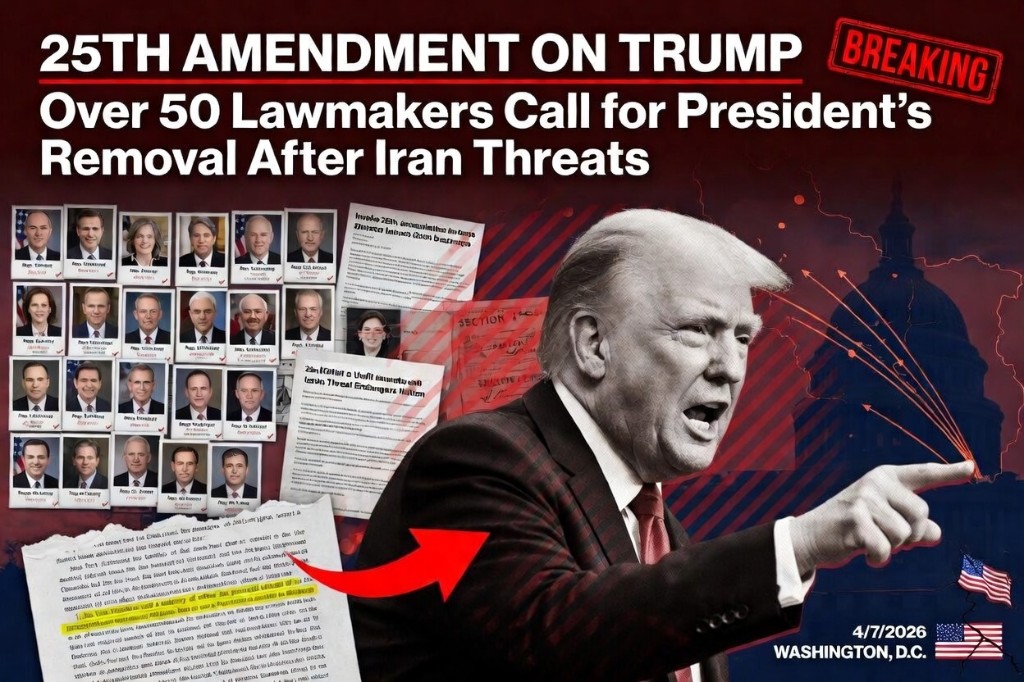
25th Amendment on Trump: Over 50 Lawmakers Call for President's Removal After Iran Threats
A growing group of Democrats — and former Trump ally Marjorie Taylor Greene — are demanding the Vice President and Cabinet invoke the 25th Amendment to remove Trump from office. Here's who's calling for it, how the process works, and what happens next.
What Happened?
On Easter Sunday, April 5, 2026, President Trump posted a message on Truth Social threatening Iran with massive strikes on bridges and power plants. He wrote that Tuesday would be "Power Plant Day, and Bridge Day" and used profanity directed at Iranian leaders. The post also included the phrase "Praise be to Allah." [3]
Then on Tuesday morning, Trump posted again. He warned that "a whole civilization will die tonight, never to be brought back again." He was talking about Iran and his 8 p.m. deadline for Tehran to reopen the Strait of Hormuz — a major shipping lane that Iran closed during the ongoing conflict.
These posts set off a firestorm in Congress. Dozens of lawmakers said Trump's threats were proof he is unfit for office. They called for his removal through the 25th Amendment or impeachment. [1]
Who Is Calling for Removal?
By Tuesday afternoon, more than 50 House Democrats, two Democratic senators, and one former Republican had publicly called for Trump's removal. [1] Here is a partial list of the lawmakers who went on the record.
| Lawmaker | Party | State | Chamber |
|---|---|---|---|
| Alexandria Ocasio-Cortez | D | NY | House |
| Diana DeGette | D | CO | House |
| Sydney Kamlager-Dove | D | CA | House |
| Mark Pocan | D | WI | House |
| Summer Lee | D | PA | House |
| Delia Ramirez | D | IL | House |
| Sarah McBride | D | DE | House |
| Yassamin Ansari | D | AZ | House |
| Ilhan Omar | D | MN | House |
| Rashida Tlaib | D | MI | House |
| Seth Moulton | D | MA | House |
| Melanie Stansbury | D | NM | House |
| Ro Khanna | D | CA | House |
| Maxwell Frost | D | FL | House |
| Ayanna Pressley | D | MA | House |
| Johnny Olszewski | D | MD | House |
| Julie Johnson | D | TX | House |
| Sara Jacobs | D | CA | House |
| Bonnie Watson Coleman | D | NJ | House |
| Lateefah Simon | D | CA | House |
| Robert Garcia | D | CA | House |
| Chellie Pingree | D | ME | House |
| Shri Thanedar | D | MI | House |
| Rob Menendez | D | NJ | House |
| April Delaney | D | MD | House |
| Nikema Williams | D | GA | House |
| Ed Markey | D | MA | Senate |
| Ron Wyden | D | OR | Senate |
| Marjorie Taylor Greene (former) | R | GA | — |
Note: This is a partial list. Additional members continued to join throughout the day. Some lawmakers called for impeachment rather than the 25th Amendment specifically.
Includes both current and former members. Updated April 7, 2026.
Why Marjorie Taylor Greene Matters
The most surprising name on the list is former Rep. Marjorie Taylor Greene. She was once one of Trump's loudest supporters in Congress. But their relationship fell apart over the past year. Greene criticized Trump's foreign policy — especially his handling of the Iran war and the Epstein files. She resigned from Congress in January 2026.
On Tuesday, Greene responded to Trump's threat by posting: "25TH AMENDMENT!!! Not a single bomb has dropped on America. We cannot kill an entire civilization. This is evil and madness." [3]
She also called on Christians in the administration to "fall on their knees and beg forgiveness from God" and said Trump had "gone insane." [6] Her break with Trump is significant because it shows the 25th Amendment push is not only a Democratic effort. However, Greene is no longer a sitting member of Congress and cannot vote on any removal action.
How Does the 25th Amendment Work?
The 25th Amendment was added to the Constitution in 1967. It was written after the assassination of President John F. Kennedy. [4] It lays out what happens when a president can no longer serve. Section 4 is the part people are talking about now. Here is how it works, step by step.
Cabinet Acts
The VP and a majority of the Cabinet send a letter to Congress saying the President is unable to serve.
VP Takes Over
The Vice President immediately becomes Acting President.
President Objects
The President can send a letter saying he is fit. This triggers a congressional vote.
Congress Votes
Two-thirds of both the House and Senate must vote to keep the President removed.
No president has ever been removed this way. Section 4 was designed for medical emergencies — for example, if a president had a stroke and could not make decisions. Using it for political reasons would be completely new in American history.
Why the 25th Amendment Almost Never Happens
Even though calls for the 25th Amendment come up during heated political moments, there are several big reasons why it has never been used to remove a president — and probably won't be used now.
The Cabinet works for the President. Every Cabinet member is picked by the president and can be fired by the president. Asking them to vote against their own boss is like asking employees to fire the CEO who hired them. They have very little reason to do it — and a lot to lose if they try and fail.
The Vice President has to lead the charge. The VP must agree and co-sign the letter to Congress. Vice Presidents are chosen specifically because they are loyal to the president. In American history, no Vice President has ever moved against a sitting president this way.
The President can fight back immediately. Even if the Cabinet and VP act, the president can simply send a letter to Congress saying "I'm fine." That letter gives the president his powers back right away — unless the VP and Cabinet object again within four days. Then Congress has 21 days to vote, and it takes a two-thirds supermajority in both chambers to keep the president out. That is an incredibly high bar.
It was built for medical crises, not politics. The framers of the 25th Amendment were thinking about situations like President Woodrow Wilson's stroke in 1919, when he was physically unable to govern for months. They were not thinking about disagreements over policy or rhetoric. Using Section 4 for political reasons would set a precedent that many lawmakers — on both sides — fear could be abused in the future.
The political cost is enormous. Any Cabinet member or VP who tried and failed would almost certainly be fired and politically destroyed. Even members of Congress who push for it risk being seen as trying to overturn an election. This makes it a last-resort option that almost nobody is willing to actually pull the trigger on.
25th Amendment vs. Impeachment: What's the Difference?
| Feature | 25th Amendment (Section 4) | Impeachment |
|---|---|---|
| Who starts it? | Vice President + majority of Cabinet | House of Representatives |
| Reason | President is "unable" to serve | "High crimes and misdemeanors" |
| Speed | Can happen immediately | Takes weeks or months |
| Congressional vote needed? | Only if President objects (⅔ of both chambers) | Yes — simple majority in House, ⅔ in Senate |
| Result | VP becomes Acting President (can be temporary) | President removed permanently |
| Ever been used to remove a president? | No | No (Nixon resigned; others acquitted) |
What the White House Says
The White House pushed back on the removal calls. Spokesperson Davis Ingle said Democrats have been trying to remove Trump "since before he was even sworn into office." He called the Democrats in Congress "deranged, weak, and ineffective." [2]
No Cabinet member has shown any sign of supporting the 25th Amendment. Multiple reports say Trump is actually the most hawkish person in his own administration when it comes to Iran. One senior official reportedly described the president as "the most bloodthirsty" person in the upper levels of the government. [5]
What Happens Next?
Democrats plan to bring up a war powers resolution when Congress returns to session next week. This would try to limit Trump's ability to strike Iran without congressional approval. However, similar resolutions about Venezuela earlier this year failed to pass.
Some Democratic lawmakers say they are working on organized action behind the scenes. But even supporters of removal admit it will not happen without Republican support. As Rep. Jim Himes put it, Republican members remain loyal to the president, making any removal action very unlikely in the short term. [1]
The 2026 midterm elections later this year may be the biggest factor. Some analysts say a Democratic majority in the House would open the door to impeachment proceedings — even if the Senate would be unlikely to convict. [4]
Frequently Asked Questions
The 25th Amendment is part of the U.S. Constitution. It was added in 1967 and explains what happens when a president dies, resigns, or becomes unable to do the job. Section 4 lets the Vice President and Cabinet remove a president who is unfit to serve.
Not on its own. The Vice President and a majority of Cabinet members must act first. Congress only votes if the President objects to being removed. That vote requires a two-thirds majority in both the House and Senate.
As of April 7, 2026, more than 50 House Democrats, at least two senators (Ed Markey and Ron Wyden), and former Republican Rep. Marjorie Taylor Greene have called for removal through the 25th Amendment or impeachment.
No. Section 4 has never been invoked in American history. Other sections have been used — for example, when President Nixon resigned and when presidents have had medical procedures — but no president has ever been forcibly removed this way.
Greene, once a strong Trump ally, broke with him over the Iran war and other issues. She called his threats against Iranian civilians "evil and madness." She resigned from Congress in January 2026 after her relationship with Trump fell apart.
The 25th Amendment is started by the Vice President and Cabinet when a president is unable to serve. Impeachment is started by the House and requires a Senate trial. The 25th Amendment can act immediately; impeachment takes much longer. Neither has ever been used to successfully remove a sitting president.
Sources
- Axios — "Trump 25th Amendment chatter erupts among Dems over Iran post" (April 7, 2026)
- The Hill — "Democrats say Trump's Iran threat cause for 25th Amendment removal or impeachment" (April 7, 2026)
- The Hill — "Marjorie Taylor Greene calls for Donald Trump's removal over 'evil' Iran rhetoric" (April 7, 2026)
- TIME — "What to Know About the 25th Amendment as Lawmakers Call for Trump's Removal" (April 6, 2026)
- Newsweek — "Marjorie Taylor Greene Demands 25th Amendment Be Invoked Against Trump" (April 7, 2026)
- Fox News — "Ex-Trump ally Marjorie Taylor Greene joins left-wing calls for the 25th Amendment" (April 7, 2026)
- Newsweek — "Trump's Odds of Being Removed by 25th Amendment Hit New Record High" (April 6, 2026)