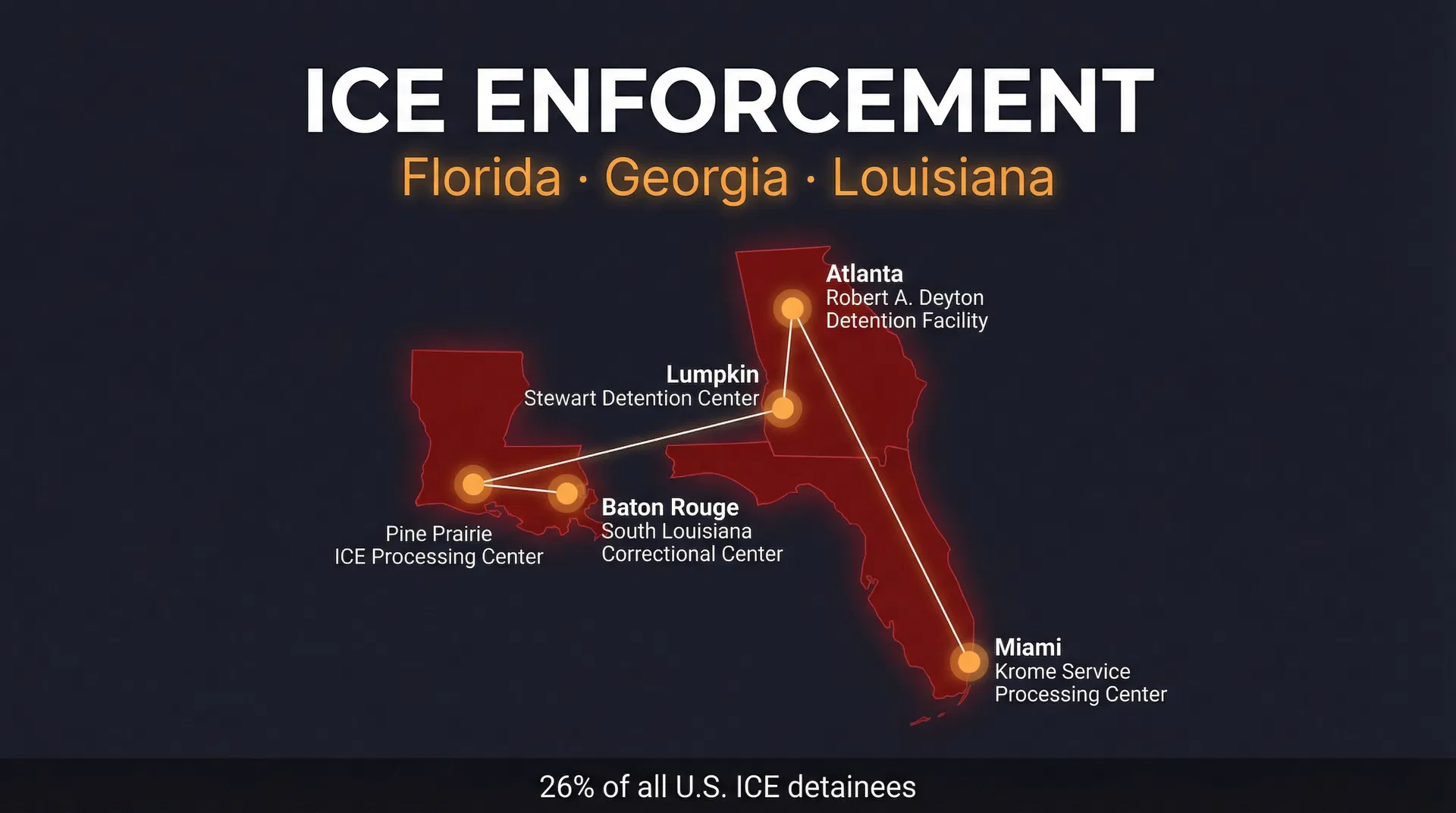
ICE in Florida, Georgia, and Louisiana
A plain-English, data-based look at how three Southern states shape immigration enforcement in 2026
Prepared for WhatsUpCongress.com · Read level: simple and public-facing · Data update: March 26, 2026
One-minute takeaway
Florida is building the broadest state-local partnership model. Georgia leans on jail cooperation and Stewart Detention Center. Louisiana is the detention engine.
Key numbers
- 68,289 people in ICE detention nationwide on Feb. 7, 2026.
- 8,244 in Louisiana, 5,231 in Florida, and 4,227 in Georgia.
- Together, the three states held about 26% of all ICE detainees.
Quick snapshot
| State | Main role | Key number | What changed |
|---|---|---|---|
| Florida | State-led partnership | 5,231 FY2026 detainees | 2025 law created a state board, grant program, and mandatory 287(g) participation for county detention operators. |
| Georgia | Jail pipeline + anchor facility | 4,227 FY2026 detainees | State law and state partnerships strengthened jail cooperation; Stewart remains a major national detention center. |
| Louisiana | Detention engine | 8,244 FY2026 detainees | Louisiana stayed second in the nation for detainees (behind only Texas) and remains central to detention and legal fights. |
Snapshot data from TRAC Immigration Detention Quick Facts (data current through Feb. 7, 2026), Florida statutes, Georgia state sources, and current reporting reviewed March 26, 2026.
The big national picture
ICE in these three states is not one single story. It is three different stories that now connect. Florida is building a broad state and local partnership model. Georgia is leaning on jail cooperation and a major detention hub. Louisiana is the detention engine, with a large share of the region's bed space and a rising number of court fights tied to detention.
That matters because ICE is not just a federal agency working alone. As of March 23, 2026, ICE said it had 1,552 active 287(g) agreements across 39 states and two U.S. territories. The 287(g) program lets trained local officers do some immigration work under ICE supervision. At the same time, TRAC reported that ICE was holding 68,289 people in detention on February 7, 2026.
Louisiana held 8,244 of those detainees. Florida held 5,231. Georgia held 4,227. Put together, those three states held 17,702 people, or about 26 percent of all ICE detainees in the country. That is why these states keep showing up in the data.
A simple way to read the system
An agreement tells you who can help ICE. A jail rule tells you who can be held and transferred. A detention center tells you where people can be kept after arrest. That three-step chain explains why these states keep showing up in the data. Florida, Georgia, and Louisiana each fill a different part of the chain, which is why they matter more together than alone.
Florida: the most systemized partnership model
Florida has the clearest statewide structure of the three states. In 2025, Florida lawmakers created a State Board of Immigration Enforcement and a grant program to help local agencies work with federal immigration agencies. The law also says that a sheriff or chief correctional officer who runs a county detention facility must enter into a 287(g) agreement with ICE.
That structure moved fast. On February 24, 2025, the Florida Sheriffs Association said every county jail in the state had signed a written 287(g) agreement with ICE. On February 19, 2025, Governor Ron DeSantis announced added memoranda of agreement for the Florida Department of Law Enforcement, the Florida Fish and Wildlife Conservation Commission, and the Florida State Guard. On September 26, 2025, ICE said Florida had 325 agreements in place.
Florida is also a large detention state. TRAC said Florida had 5,231 ICE detainees in FY2026 year-to-date data through early February. Krome North Service Processing Center in Miami has become a symbol of facility strain — TRAC reported that in FY2025, Krome's maximum one-day population hit 1,806 people, against a contractual capacity of just 611.
Georgia: a jail pipeline with one giant anchor
Georgia combines legal pressure on local jails with one of the biggest detention centers in the country. Georgia's Criminal Justice Coordinating Council explains the 287(g) program under state law as a way to let ICE work with state and local agencies to identify and remove noncitizens in custody. In 2024, Georgia passed House Bill 1105 (the Georgia Criminal Alien Track and Report Act), which requires local law enforcement to notify federal officials when they have people without legal status in their jails and, when possible, transfer them for immigration detention.
On March 17, 2025, Governor Brian Kemp and the Georgia Department of Public Safety announced a further ICE partnership. The Georgia Department of Corrections already participated in 287(g) through the Jail Enforcement Model, with roughly 1,730 people on ICE detainers at that time.
The biggest reason Georgia matters is Stewart Detention Center in Lumpkin — one of the most important ICE detention centers in the country. TRAC's July 2025 overcapacity report said Stewart's FY2025 maximum population reached 2,312, above its contractual capacity of 1,966.
Louisiana: the detention engine
TRAC reported that Louisiana held 8,244 ICE detainees in FY2026 year-to-date data through early February — second in the nation behind only Texas. Louisiana is much smaller than Florida or Georgia, yet it holds more ICE detainees than either. In the current system, detention bed space can matter more than state population.
Louisiana's role is tied to the New Orleans ICE Field Office and a large detention network across the state. Public reporting in early 2026 said the New Orleans field office issued nearly 30,000 immigration detainers from January 1, 2024, through October 15, 2025. Key facilities include Pine Prairie ICE Processing Center, Louisiana ICE Processing Center, Central Louisiana ICE Processing Center, South Louisiana ICE Processing Center, and Winn Correctional Center.
Pine Prairie's FY2025 maximum population hit 923, above its contractual capacity of 500. Legal pressure is also rising fast: Verite News reported on March 9, 2026, that immigrants filed 378 cases in Louisiana federal courts in just the first two months of 2026 alleging unlawful detention, compared with just 29 in all of 2024.
Three facilities that show the pressure
| Facility | State | Capacity | Max pop. | Gap |
|---|---|---|---|---|
| Krome North Service Processing Center | FL | 611 | 1,806 | +1,195 |
| Pine Prairie ICE Processing Center | LA | 500 | 923 | +423 |
| Stewart Detention Center | GA | 1,966 | 2,312 | +346 |
When a center's population rises far above its contractual capacity, the result is not just a bigger number on a chart. It can mean more pressure on staffing, transport, scheduling, housing, and daily operations. It is one of the clearest warning signs in the public data.
How the three states differ on the ground
In Florida, the system feels designed. The law creates a board. The board can move grant money. County jail operators must sign 287(g) agreements. State agencies also joined in. That makes Florida look less like a patchwork and more like a planned network.
In Georgia, the system feels more like a funnel. Local booking, jail checks, notice to federal officials, and transfer pathways matter a lot. Then Stewart sits at the end of that path as a giant holding point.
In Louisiana, the system feels like a warehouse and transit zone. People can be moved in from different places, held for long stretches, and become part of a court system that is now handling many more detention challenges.
Three data points that say a lot
- ICE had 1,552 active 287(g) agreements on March 23, 2026 — the whole system is getting more local.
- TRAC said ICE held 68,289 people on February 7, 2026 — the detention side is still very large and still growing.
- Louisiana, Florida, and Georgia together held about 26 percent of all ICE detainees — a huge share for just three states in one region.
What to watch next
- 287(g) growth: If the national count keeps rising, Florida will likely stay the model for broad state-local expansion.
- Detention pressure: Krome, Pine Prairie, and Stewart all show how fast over-capacity pressure can build.
- The courts: Louisiana is the clearest sign that detention growth brings more legal conflict.
- Other states copying Florida's funding model: If more states build grants, reporting, and state boards, the federal-local enforcement map could change even faster.
Bottom line
Florida is the state-partnership model. Georgia is the jail-pipeline model with a giant detention anchor. Louisiana is the detention-engine model. That is the clearest way to understand the ICE picture in these three states as of March 26, 2026.
FAQ
What is 287(g)? A federal program that lets trained state or local officers do some immigration enforcement work under ICE supervision, making local agencies part of the enforcement picture.
Why is Florida such a big story? Because Florida moved past one-off local cooperation. It built state law, grants, a state board, and broad county jail participation — making the system durable, not just temporary.
Why does Louisiana hold more people than Florida or Georgia? Because Louisiana has a large detention network. In the current system, bed space matters a lot. A smaller state can become very important if it supplies many places to hold detainees.
Are these numbers fixed? No. Detention and agreement counts can change quickly. The dates in this report matter — public numbers are snapshots, not permanent totals.
Data sources
- TRAC Immigration Detention Quick Facts: national detainee total and state totals for Louisiana, Florida, and Georgia.
- ICE 287(g) program page: nationwide count of active 287(g) memorandums of agreement as of March 23, 2026.
- Florida Statutes, chapter 908: creation of the State Board of Immigration Enforcement, grant program authority, and 287(g) requirements for county detention operators.
- Florida Sheriffs Association, February 24, 2025: statement that every county jail in Florida had signed a written 287(g) agreement.
- Governor Ron DeSantis press release, February 19, 2025: additional Florida memoranda of agreement involving FDLE, FWC, and the Florida State Guard.
- ICE release, September 26, 2025: Florida had 325 287(g) agreements in place.
- Georgia Criminal Justice Coordinating Council 287(g) page: official state description of the program under Georgia law.
- Governor Brian Kemp and Georgia Department of Public Safety release, March 17, 2025.
- TRAC report, July 8, 2025, "ICE Contractual Capacity and Number Detained": facility capacity and maximum population data for Krome, Pine Prairie, and Stewart.
- Louisiana reporting reviewed March 2026, including New Orleans field office detainer activity and rising unlawful detention litigation in federal court.