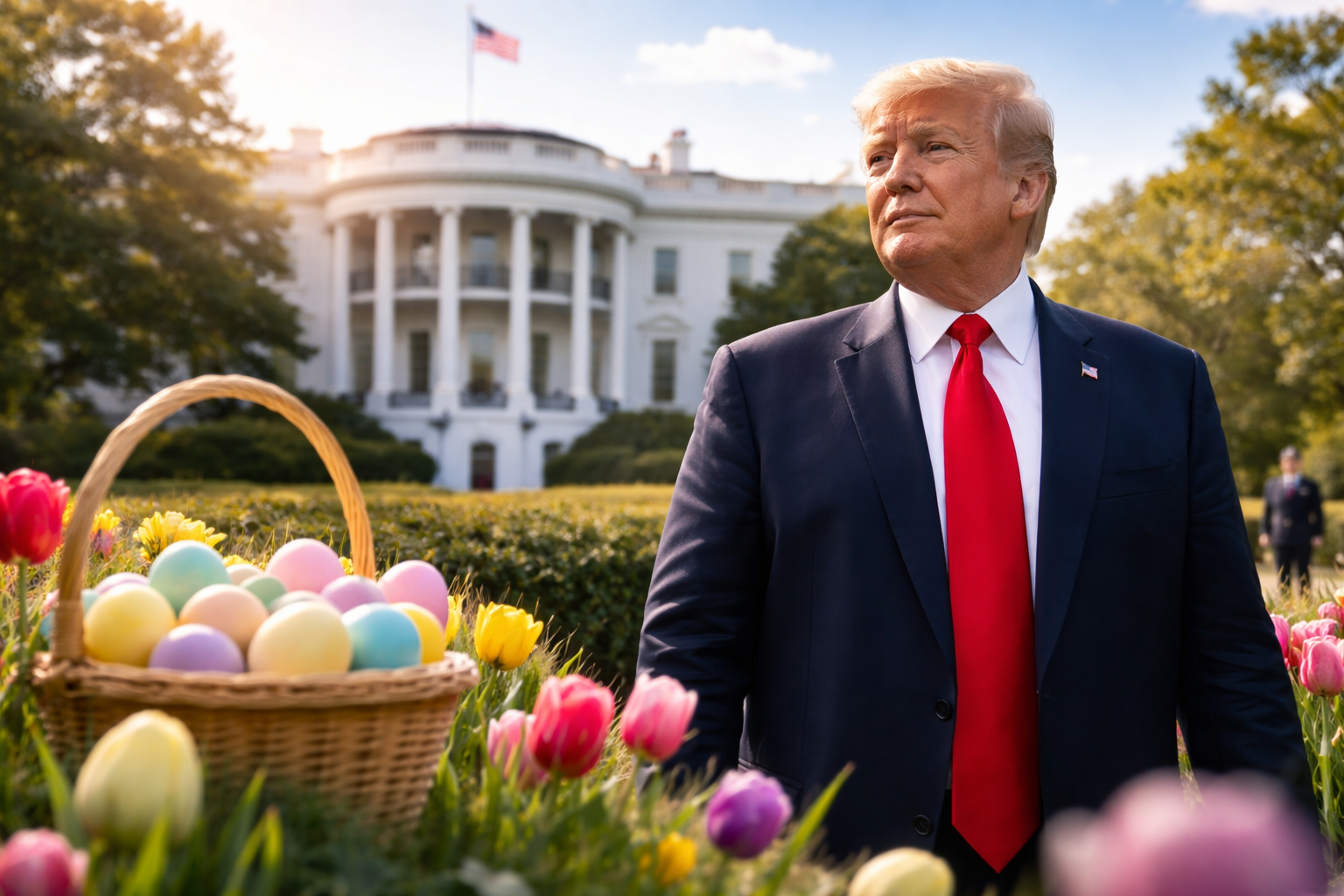
Most Americans spent Easter Sunday 2026 at church, around the dinner table, or hiding eggs for their kids. President Donald Trump spent his doing something else entirely: issuing a profanity-laced ultimatum to Iran on social media, celebrating the dramatic overnight rescue of a U.S. airman shot down behind enemy lines, and sitting for a string of combative television interviews — all while skipping church services.
It was, by any measure, an unusual Easter. And what happened today has direct implications for the gas you're pumping tomorrow, the military families watching the news tonight, and the economic anxiety millions of Americans are already feeling at the checkout line.
The Morning Post That Changed the Day
At 8:03 a.m. Eastern, Trump took to Truth Social with a message that would dominate the news cycle. He threatened to destroy Iranian power plants and bridges by Tuesday if Tehran does not reopen the Strait of Hormuz, a narrow waterway through which roughly one-fifth of the world's oil normally flows. He set a new deadline of Tuesday at 8:00 p.m. ET for Iran to reach a deal with the United States.
The post was jarring not just for its content but for its timing — posted on Easter morning, the holiest day on the Christian calendar, marking the resurrection of Jesus Christ. According to his daily schedule, the President had no church attendance planned. The White House listed a private Easter dinner with First Lady Melania Trump following closed-door executive time. The setting itself carried an edge: the Secret Service investigated reports of gunfire near Lafayette Park overnight, just across from the White House. No injuries were reported and operations were unaffected, but security was heightened — a reminder that even a family holiday now unfolds inside a fortified perimeter.
Reactions broke sharply along political lines. Some prominent supporters praised the aggressive posture. Former Rep. Marjorie Taylor Greene, an opponent of the Iran war, took a starkly different view, calling the post evidence that the President had lost his way and urging administration officials who identify as Christians to reconsider their support of the current military campaign.
What circulated on Truth Social and X
These bullets mimic how posts looked in coverage, but the wording is our paraphrase of reporting — not verbatim quotes or copied from the platforms. Times Eastern. The last item is a televised Cabinet remark, not a Truth Social post.
- Truth Social · ~8:03 a.m. ET, April 5, 2026 — Paraphrase of reporting: Threatened to destroy Iranian power plants and bridges by Tuesday unless Tehran reopened the Strait of Hormuz, with a Tuesday 8:00 p.m. ET deadline for a U.S.–Iran deal.
- Truth Social · overnight into Easter — Paraphrase of reporting: “WE GOT HIM!” — celebrating the rescued airman; Trump called it an Easter miracle.
- X · Chris Murphy (@ChrisMurphyCT) — Paraphrase of his reported post: If I were in Trump’s Cabinet, I’d spend Easter consulting lawyers on the 25th Amendment; called the Iran post “completely, utterly unhinged.”
- Cabinet room on camera · March 27, 2026 (not Truth Social) — Reported remark: Joked that revealing military plans would mean they would “probably institute the 25th Amendment.”
25th Amendment Calls Trend on Easter Sunday
By mid-afternoon, the phrase "25th Amendment" was trending on X. The post triggered a wave of calls — from Democratic lawmakers, former Trump allies, and legal commentators — for Vice President JD Vance and a majority of the Cabinet to invoke Section Four of the amendment, which provides for removing a president deemed unable to discharge the duties of office.
Senator Chris Murphy (D-CT) wrote on X that if he were in Trump's Cabinet, he would spend Easter consulting constitutional lawyers about the 25th Amendment, calling the post "completely, utterly unhinged." Senator Tim Kaine (D-VA) said on NBC's Meet the Press that the pattern of threatening language throughout the war reflects an absence of a coherent plan or rationale. Anthony Scaramucci, Trump's first-term White House communications director, also called for removal.
The calls are not new. Earlier in the week, Ty Cobb — who served as White House counsel during Trump's first term — said on air that the President is "clearly insane" and questioned why the Cabinet has not already acted. Trump himself appeared aware of the chatter, joking at a March 27 Cabinet meeting that if he revealed his military plans, they would "probably institute the 25th Amendment." Prediction markets reflect the uncertainty: Kalshi puts the probability of removal before year's end at 33%, while Polymarket prices it at 8%.
For context, the 25th Amendment has never been used to involuntarily remove a sitting president. Invoking it would require the vice president and a majority of Cabinet secretaries to agree the president cannot serve — a scenario with no precedent in American history. The White House has not commented on the latest calls.
The Airman Rescue: An "Easter Miracle"
Beneath the social media storm, a genuine act of courage had unfolded overnight. On Friday, an American F-15E Strike Eagle was shot down over southwestern Iran — the first U.S. fighter jet downed by enemy fire since the war began in late February. The pilot was rescued quickly, but the second crew member, a weapons systems officer described as a colonel, was stranded in rugged mountain terrain with Iranian search parties and a $60,000 bounty closing in.
What followed was a joint CIA and military operation that officials described as finding a needle in a haystack. The CIA launched a deception campaign inside Iran to confuse search parties, then used intelligence capabilities to locate the airman hiding in a mountain crevice. U.S. aircraft bombed approaching convoys to protect his position. He was extracted by MC-130J transport planes and brought out of the country, injured but alive.
Trump announced the rescue shortly after midnight, posting "WE GOT HIM!" on Truth Social and calling it an Easter miracle. The airman was described as seriously wounded but expected to recover. Trump said a military news conference would take place Monday afternoon from the Oval Office — expected to cover both the rescue and the broader state of the conflict.
What This Means at the Gas Pump
Here's where Easter Sunday's events hit closest to home. Trump's Tuesday deadline is not just geopolitical theater — it is directly connected to what every American pays for fuel, food, and flights.
By the Numbers: The Gas Price Surge
- National average gas price as of this weekend: $4.110/gallon (AAA), up from $2.98 on February 26 — a 38% spike in five weeks
- California drivers are paying $5.89/gallon, the highest in the nation
- Brent crude oil closed at approximately $113/barrel last week, with spot prices hitting $141 in some markets
- The average American household faces an estimated $1,000+ increase in annual fuel costs at current price trajectories
- Economists warn prices could reach $150–$200/barrel if the Strait stays closed through mid-April
Iran's blockade of the Strait of Hormuz, now entering its second month, has created what the International Energy Agency's chief called the worst energy supply shock in history. In March alone, Brent crude surged more than 60% — the steepest monthly climb since records began in the 1980s. The effects are cascading: airlines are canceling flights across Europe and Asia due to jet fuel shortages, fuel rationing has begun in parts of Southeast Asia and South Asia, and European nations are pushing for emergency windfall taxes on energy companies.
The United States is better insulated than most countries, thanks to domestic production and its position as the world's largest LNG exporter. OPEC+ has agreed to raise output quotas for May, though analysts say the increase is more symbolic than immediate given the physical constraints of the blockade. But Americans are not immune. Gas prices are the top concern for 86% of U.S. adults, according to recent consumer confidence surveys, and the trajectory is clear: if the Strait remains closed, prices will keep climbing.
| Date | National Avg. Gas Price | Brent Crude (approx.) | Key Event |
|---|---|---|---|
| Feb 26 | $2.98 | ~$74 | Pre-war baseline |
| Feb 28 | $3.01 | ~$78 | U.S.–Israeli strikes begin |
| Mar 8 | $3.25 | $100+ | Brent crosses $100/bbl |
| Mar 26 | $3.98 | ~$90 | $1 increase in one month |
| Apr 5 | $4.110 | ~$113 | Easter Sunday — Trump's Tuesday deadline |
The View From the Pews — And the Vatican
The contrast between the President's Easter and other leaders' observances was stark. Just two days earlier, Trump delivered a formal Easter video message from the Oval Office — a traditional, faith-forward address quoting the Gospel of John and praising what he called a religious revival in America. He cited a 2025 Barna study showing that 66% of U.S. adults say they have a personal commitment to Jesus Christ, a 12-point rise since 2021.
That tone was nowhere to be found by Sunday morning. The result is a split-screen presidency on full display: one message aimed at Christian conservatives through traditional faith language, another aimed at his broader base through a show of military resolve. The two audiences received two different Easters from the same White House on the same day — faith and redemption on Saturday, threats and ultimatums on Sunday. For supporters, it reads as conviction. For critics, it reads as the blending of a holy day with conflict. Either way, no other modern president has so openly projected both messages simultaneously on Easter.
Meanwhile, Pope Leo XIV — the first American-born pope — used his inaugural Easter Mass at St. Peter's Basilica to deliver a pointed call for peace. He urged those with power to choose dialogue over domination and described Easter's message as entirely nonviolent.
In the U.K., the Archbishop of Canterbury called for an end to violence in the Middle East. In Lebanon, Easter services overlapped with funerals following fresh Israeli strikes. In Tel Aviv, thousands protested the war before police dispersed the crowd under wartime restrictions on large gatherings.
Tomorrow: The Easter Egg Roll Goes On
Against this backdrop, the White House is preparing for Monday's Easter Egg Roll on the South Lawn — one of Washington's oldest traditions and, for many families, a rare moment of normalcy. This year's event carries a patriotic theme marking America's 250th anniversary. Activities include traditional egg rolls and egg hunts, a sensory-friendly hunt, military family card-writing stations, and a range of interactive exhibits hosted through partnerships with the White House Historical Association.
Each departing family will receive an official Easter egg bearing the signatures of both the President and First Lady. Approximately 500 volunteers are making the event possible.
What to Watch This Week
The next 72 hours may be the most consequential of the five-week-old conflict. Trump's Tuesday evening deadline is the latest in a series of ultimatums he has issued to Tehran, each one raising the stakes. In television interviews on Sunday afternoon, he told one outlet he would not rule out sending ground troops, told another he was considering destroying Iranian oil infrastructure, and told a third he has no idea whether a deal is possible.
Behind the scenes, Oman has been conducting last-ditch diplomatic talks with Iran, while Pakistan and Egypt have worked to keep communication lines open between Washington and Tehran. Iran's position, as stated by senior officials on Sunday, is that the Strait will remain blocked until Iran receives compensation for war damages — a demand the U.S. has shown no interest in meeting.
For average Americans, the practical question is straightforward: will the Strait reopen before the economic pain gets significantly worse? Oil industry analysts warn that mid-April is the inflection point. Existing oil shipments that were already in transit when the blockade began have now been delivered. From here, the supply gap widens every day.
"The next month, April, will be much worse than March. In March there were still some cargo ships carrying oil that transited through the Strait before the war broke out. They are still coming to ports. In April, there is nothing."
— Fatih Birol, Executive Director, International Energy Agency
Easter 2026 will be remembered as a day that crystallized the competing realities of this moment in American life: a war abroad escalating on social media, a daring military rescue that united the nation for a few hours, gas prices climbing toward levels not seen since 2022, and a president who spent the morning of the holiest Christian holiday threatening destruction rather than attending services.
What happens Tuesday may determine whether the next chapter of this story is about diplomacy — or about $5 gas and a wider war.