On the night of February 28, 2026, the United States began bombing Iran. There was no vote in Congress. No debate on the House or Senate floor. No formal declaration of war. President Trump ordered the strikes — called Operation Epic Fury — and the military carried them out.
In the weeks since, lawmakers from both parties have asked a simple but powerful question: Is this even legal?
The answer depends on who you ask. But at the center of this debate is a 53-year-old law called the War Powers Act — and understanding how it works has never been more important.
Related Article Military Draft 2026: Why Draft Searches Are Surging and What It Means for You →First, the Basics: Who Gets to Decide If America Goes to War?
The U.S. Constitution makes this pretty clear. Article I, Section 8 says that Congress has the power to declare war. Not the President. The people who wrote the Constitution did this on purpose. They had just fought a revolution against a king who could send soldiers to war whenever he wanted. They didn't want any single person to have that kind of power in their new country.
But the Constitution also says the President is the Commander-in-Chief of the military. That means once troops are deployed, the President is in charge of directing them.
See the problem? Congress is supposed to decide if we go to war. The President is supposed to decide how the war is fought. In practice, though, these two powers have been blurring together for decades. Presidents from both parties have launched military operations — in Korea, Vietnam, Libya, Syria, and now Iran — without getting a formal declaration of war from Congress first.
What Is the War Powers Act?
The War Powers Resolution of 1973 — most people just call it the War Powers Act — was Congress's attempt to draw a line in the sand.
It was passed during the Vietnam War, a conflict that dragged on for years and killed over 58,000 Americans. Many in Congress felt they had been tricked and sidelined as Presidents Johnson and Nixon escalated the war without proper approval. So in 1973, Congress passed this law over President Nixon's veto to make sure it never happened again.
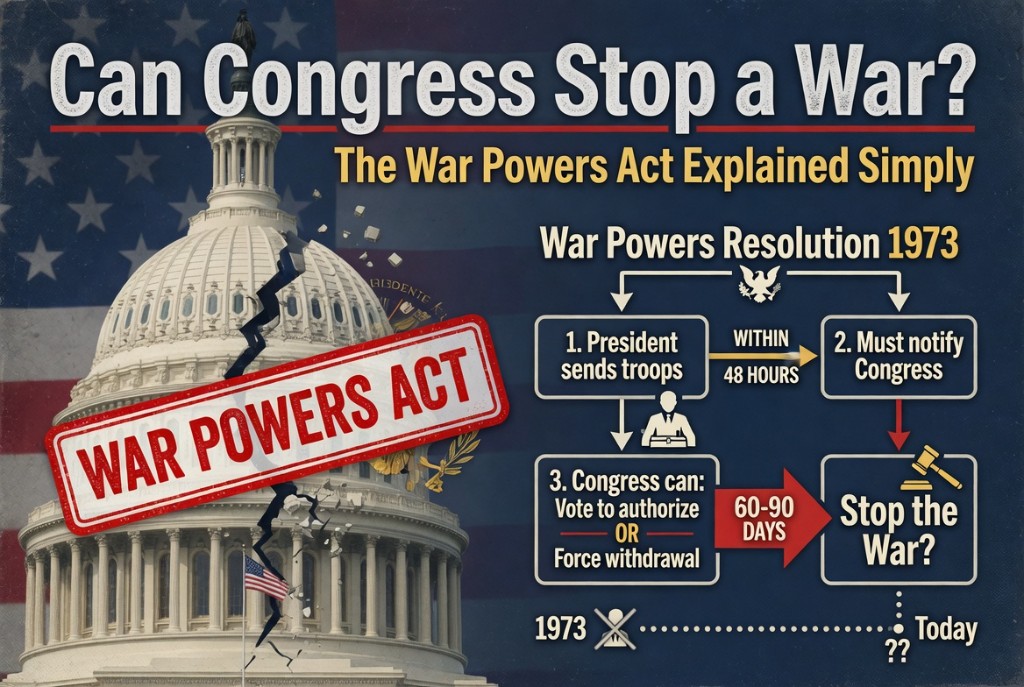
Here's what the law says, in simple terms:
1. Tell Congress fast. If the President sends troops into combat, they must notify Congress in writing within 48 hours.
2. Get approval or get out. The military cannot stay in a combat zone for more than 60 days (plus 30 extra days for safe withdrawal) unless Congress officially authorizes the mission through a declaration of war or a specific vote.
3. Congress can force a pullout. Any member of Congress can introduce a resolution directing the President to withdraw forces from a conflict. If both chambers pass it, the President is supposed to bring the troops home.
That sounds pretty powerful, right? In theory, it is. In practice, it's a very different story.
What Happened With the Iran War Powers Vote?
Within hours of the first bombs falling on Iran, members of Congress started pushing for a war powers vote. The two key resolutions were:
In the Senate: A bipartisan resolution co-sponsored by Sen. Tim Kaine (D-VA) and Sen. Rand Paul (R-KY) that would have required the President to get congressional authorization before continuing military operations in Iran.
In the House: H.Con.Res.38, introduced by Rep. Thomas Massie (R-KY) and Rep. Ro Khanna (D-CA), directing the President to remove U.S. forces from hostilities against Iran unless Congress passed a declaration of war or formal authorization.
Both votes happened during the first week of March 2026. Both failed.
The votes mostly fell along party lines. In the House, only two Republicans — Massie and Rep. Warren Davidson of Ohio — voted in favor. Four Democrats voted against it: Reps. Henry Cuellar (TX), Jared Golden (ME), Greg Landsman (OH), and Juan Vargas (CA). In the Senate, Sen. John Fetterman (D-PA) was one of the few Democrats who voted no.
House Speaker Mike Johnson argued the U.S. was "not at war" but engaged in a "defensive operation." Hours later, President Trump contradicted him, using the word "war" himself during a public event.
Why Does the War Powers Act Keep Failing?
If the law is supposed to let Congress stop a war, why has it never actually worked? There are several reasons.
The veto wall
Even if both the House and Senate pass a war powers resolution, the President can veto it. To override that veto, Congress needs a two-thirds vote in both chambers — 290 votes in the House and 67 in the Senate. That's an incredibly high bar. In the entire history of the War Powers Act, Congress has never successfully overridden a presidential veto of a war powers resolution.
Party loyalty
When a president from your party launches a military operation, voting to stop that operation feels like a betrayal — especially while troops are in harm's way. The pressure to "support the troops" by supporting the mission is enormous. As Sen. Bill Cassidy (R-LA) put it after the March briefing: "You can't be halfway pregnant. We're in there."
The "rally around the flag" effect
At the start of any military conflict, public opinion tends to swing behind the President. Lawmakers who vote against a war powers resolution can say they're supporting the troops. Lawmakers who vote for it risk being accused of undermining soldiers in combat. That's a tough political position, especially in an election year — and 2026 is a midterm election year.
Legal gray zones
No court has ever fully tested the War Powers Act. Presidents from both parties have argued the law is unconstitutional because it limits the Commander-in-Chief's power. Courts have generally avoided ruling on war powers disputes, treating them as political questions between Congress and the President. As one legal expert put it: a court could order a president to stop, but "what if Trump doesn't comply? Then we can have a constitutional crisis."
A Brief History: This Has Happened Before
The Iran situation isn't the first time Congress has struggled to use the War Powers Act. Here's a quick look at the pattern:
The pattern is clear: presidents act, Congress reacts, and the resolutions fail. Every time.
What's Happening Right Now?
On April 7, 2026, a fragile two-week ceasefire between the U.S. and Iran was announced, brokered by Pakistan. But the ceasefire is already shaky. Israel launched massive strikes on Lebanon on the first day, saying Lebanon isn't covered by the deal. Iran accused the U.S. of violating the agreement. Ships still can't move freely through the Strait of Hormuz.
Meanwhile, Democrats in Congress are not giving up. Senate Minority Leader Chuck Schumer announced on April 9 that Democrats will force another war powers vote when the Senate comes back from recess. House Minority Leader Hakeem Jeffries said Democrats are in "active conversations" with Republicans to flip enough votes, saying they need only "an additional handful" to pass a resolution.
Rep. Jamie Raskin (D-MD) has also scheduled a meeting to discuss the 25th Amendment — the constitutional provision for removing a president who is unable or unwilling to perform their duties. While this is a separate issue, it shows how heated the debate over presidential power has become.
Why This Matters for Every American
This might seem like a fight between politicians in Washington, but it affects every single American. Here's why.
It's about who decides if your family members go to war. If the President can launch military strikes without asking Congress, that means one person — not the 535 elected representatives of the American people — is making the most serious decision a government can make.
It's about your tax dollars. The Pentagon has reportedly requested $200 billion to fund operations in Iran. That money comes from American taxpayers. The Constitution says Congress controls the federal budget. If Congress didn't authorize the war, should it fund the war?
It's about the future. Every time a president launches a military operation without congressional approval and Congress fails to stop it, a new precedent is set. Future presidents — of either party — will point to what happened before and claim the same authority. The power grows with each unchecked use.
Six U.S. service members have died in Operation Epic Fury so far. American families are grieving. American troops remain in harm's way during a ceasefire that could collapse at any moment. Whether or not you support the mission, the question of who has the right to send those men and women into danger is one of the most fundamental questions in our democracy.
What Can You Do?
The Founders gave Congress the power to declare war because Congress answers directly to you. Every member of the House is up for re-election in November 2026. A third of the Senate is too. Their votes on war powers — and on funding the war — are public record.
You can look up exactly how your representatives voted on the Iran war powers resolution. You can call their offices and tell them what you think. You can make this issue matter in the midterm elections. In a democracy, the final check on power isn't a law or a court — it's the voters.
The Bottom Line
The War Powers Act was built to stop presidents from waging war alone. But it has never successfully done so. With the Iran war in a fragile ceasefire and another vote on the horizon, this 53-year-old law is being tested again. The outcome won't just shape this war — it will define who has the power to start the next one.
Frequently Asked Questions
What is the War Powers Act?
The War Powers Act (officially the War Powers Resolution) is a 1973 federal law that requires the President to notify Congress within 48 hours of sending forces into combat and limits unauthorized military deployments to 60 days. It also allows Congress to force a vote on withdrawing troops from a conflict.
Can Congress stop the Iran war?
In theory, yes — by passing a war powers resolution. In practice, it's extremely difficult. Both the House (212-219) and Senate (47-53) rejected war powers resolutions in March 2026. Even if passed, the President would likely veto it, and overriding a veto requires a two-thirds vote in both chambers.
Who has the power to declare war — the President or Congress?
The Constitution gives Congress the sole power to declare war (Article I, Section 8). The President is the Commander-in-Chief once forces are deployed. In practice, modern presidents have launched major military operations without formal congressional declarations of war.
Did Congress vote on the Iran war?
Congress did not vote to authorize the Iran war before it began on February 28, 2026. Afterward, war powers resolutions to limit the President's authority were voted on and rejected in both chambers in early March. Senate Democrats plan another vote in April 2026.
What is H.Con.Res.38?
A House resolution introduced by Reps. Thomas Massie (R-KY) and Ro Khanna (D-CA) directing the President to withdraw U.S. forces from Iran unless Congress passes a formal declaration of war or authorization. It failed 212-219 on March 5, 2026.
Has the War Powers Act ever actually stopped a war?
No. Despite being invoked many times since 1973, the War Powers Act has never successfully forced a president to end a military operation. Presidents have argued the law is unconstitutional, and Congress has never overridden a presidential veto of a war powers resolution.
Why did some Democrats vote against the war powers resolution?
Four House Democrats — Cuellar (TX), Golden (ME), Landsman (OH), and Vargas (CA) — voted against it, along with Sen. Fetterman (PA) in the Senate. Reasons varied, with some arguing it could undermine troop safety during active combat.
What is the 60-day clock in the War Powers Act?
The law says unauthorized military deployments must end within 60 days (plus a 30-day withdrawal period). For the Iran war, which began February 28, the 60-day mark falls around April 29, 2026. However, no president has ever been forced to comply with this deadline.
Sources
- Congress.gov — H.Con.Res.38, 119th Congress
- NPR — "House rejects measure to constrain Trump's authorities in Iran" (Mar 5, 2026)
- CBS News — "House votes down resolution to curb Trump's Iran war powers" (Mar 5, 2026)
- TIME — "House Rejects War Powers Resolution on Iran" (Mar 5, 2026)
- TIME — "The Democrats Who Voted Against the War Powers Resolution" (Mar 8, 2026)
- TIME — "After Iran Strikes, Congress Confronts Its Limited Power Over War" (Mar 2, 2026)
- NPR — "Congress gears up for vote on Trump's war powers in Iran" (Mar 2, 2026)
- ABC News — "House fails to adopt Iran war powers resolution" (Mar 6, 2026)
- The Hill — "Senate to vote on war powers resolution on Trump's Iran actions" (Apr 9, 2026)
- Common Dreams — "As Trump-Iran Truce Frays, Dem Leaders Pursue Yet Another Round of War Powers Votes" (Apr 8, 2026)
- Northeastern University — "Could Congress Use Its War Powers to Halt Trump's War in Iran?" (Mar 2, 2026)
- House Clerk — Roll Call Vote 85: H.Con.Res.38 (Mar 5, 2026)
- NBC News — "House Republicans rebuff Democratic push to constrain Trump on war with Iran" (Apr 10, 2026)
- Arms Control Association — "Tell Congress to Approve the Iran War Powers Resolution" (Mar 2026)