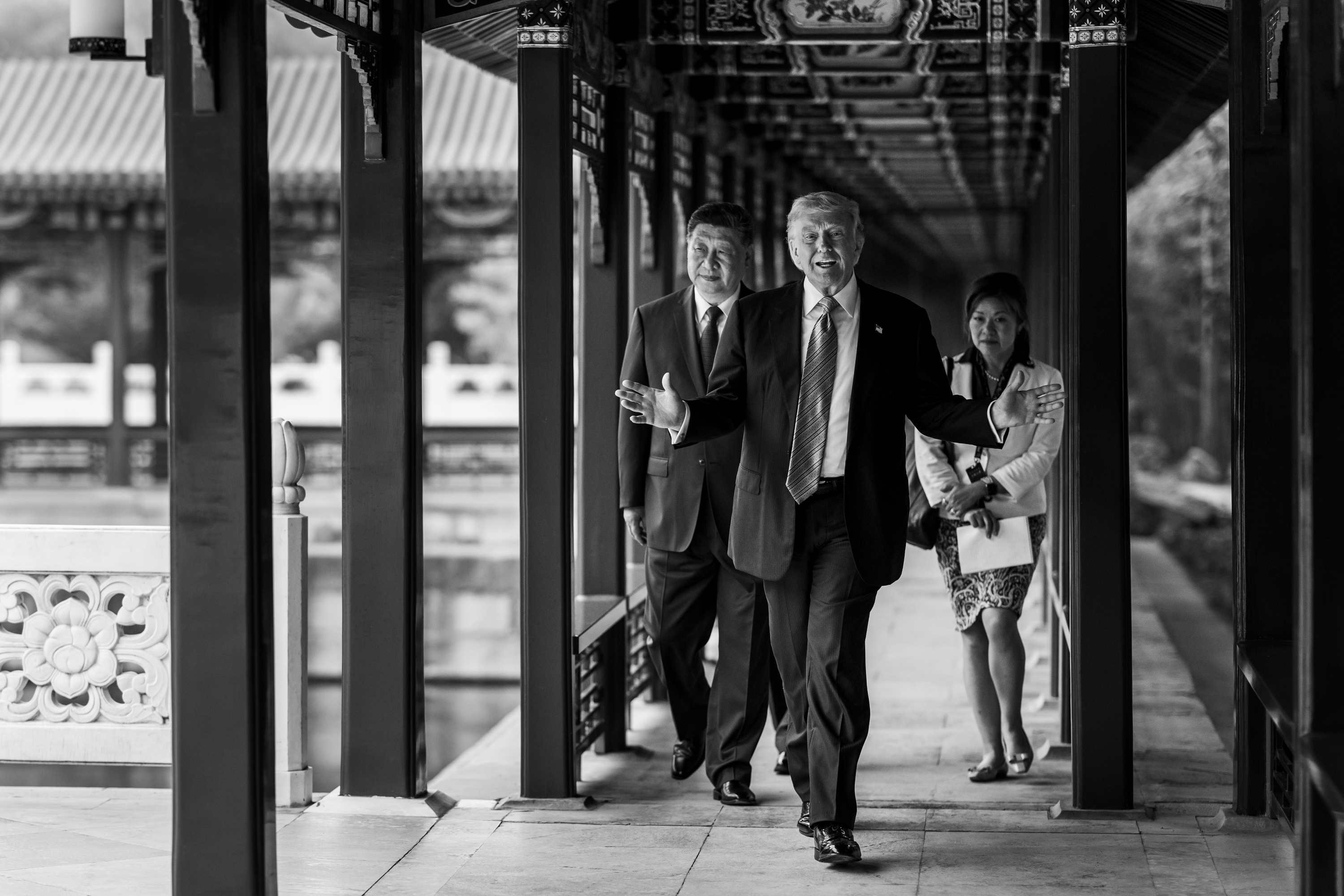
- Trump visited China May 13-15, 2026 — the first U.S. president to set foot there in nearly nine years.
- Xi gave Trump a rare private tour of Zhongnanhai, China's secret 1,500-acre Communist Party leadership compound. Only four U.S. presidents have ever entered. Xi promised to send rose seeds for the White House Rose Garden.
- The deals went both ways: China to buy 200 Boeing jets (~$30-40 billion). The U.S. approved Nvidia H200 AI chip sales to ten Chinese tech giants and suspended a $13B Taiwan arms sale. No formal treaty signed — agreements in principle only.
- What most Americans don't know: By the purchasing-power measure, China's economy passed the U.S. in 2014 and is now about 37% larger.
- China is 10-15 years ahead in specific areas: high-speed rail, electric vehicles, solar, mobile payments, autonomous drone delivery, and commercial air taxis (already flying paying passengers in Guangzhou and Hefei).
- Daily life looks different: Median Chinese income is ~$13K vs U.S. ~$80K, but rent, food, transit, healthcare, and tuition cost 3-10x less. Gun deaths are more than 10x lower than in the U.S.
- The tariff myth: Federal Reserve and Goldman Sachs studies confirm U.S. businesses and consumers pay about 88% of tariff costs — not China.
- By 2035: Goldman Sachs, IMF, and CEBR all project China's nominal economy reaches parity with or surpasses the U.S. By PPP, China widens its lead to roughly 67% larger. China is set to dominate clean energy (5+ TW wind/solar vs. U.S. 0.9 TW), EVs (80%+ of new sales), batteries, solar, and the rare-earth supply chain.
- The cost of treating China as a foe: An estimated $1,000-$2,000 more per year per American household in higher prices on electronics, clothing, home goods, toys, medicine, solar panels, EV batteries, and food. The article argues China is not our foe — China should be our strong ally.
- What's next: Xi invited to Washington for a state visit on September 24, 2026.
- Bottom line: Big on pageantry, light on signed paperwork. But two great powers are talking again, and that matters for jobs, prices, and the risk of war.
When most Americans picture China, they still see the country they saw on the news in the 1980s. Bicycles instead of cars. Gray buildings. People in matching blue jackets. A faraway place that didn't have much to do with the United States.
That picture is more than forty years out of date. And this past week, when President Donald Trump landed in Beijing for a three-day state visit, the gap between the old picture and the real one got harder to ignore.
Trump's trip ran from May 13 to May 15, 2026. It was the first time an American president had set foot in China in almost nine years. The cameras caught the big moments. The handshakes. The honor guards. The long red carpets. But a lot of what happened didn't make it onto the evening news.
The most surprising part? On his last morning, Trump walked through a place almost no American has ever seen with his own eyes. A place so secret that Chinese mapping apps blur it out. A place ringed by walls hundreds of years old, watched over by an elite military unit, and closed to the public for as long as anyone can remember.
It's called Zhongnanhai. And this is the story of what really happened there, what happened during the rest of the trip, and why this visit may matter for every American family, every American farm, and every American business.
What is Zhongnanhai?
The name Zhongnanhai (you say it "Zhong-Nan-High") means "Central and Southern Seas." It's named after two lakes that sit inside the compound. The whole place covers about 1,500 acres, which is bigger than New York's Central Park.
It sits in the very middle of Beijing, right next to the Forbidden City. You may have heard of the Forbidden City. That was where Chinese emperors lived for almost 500 years, from the Ming dynasty until 1912. Tourists can visit it today.
But Zhongnanhai is different. While the Forbidden City was the emperor's palace, Zhongnanhai was the emperor's backyard. It was the imperial garden. The place where emperors went to relax, to walk, to think, and to get away from the busy work of running the country. It had ponds and pavilions and ancient trees. Some of those trees are still standing today. One of them, Chinese President Xi Jinping told Trump during their walk, is 490 years old. Others are more than 1,000 years old. They were already old when Christopher Columbus sailed for the New World.
After the last Chinese emperor lost his throne in 1912, Zhongnanhai changed hands a few times. But in 1949, when Mao Zedong and the Chinese Communist Party took over the country, Mao made an important choice. He didn't want to move into the Forbidden City. That would have made the new Communist government look too much like the old emperors. Instead, he turned Zhongnanhai, the old imperial garden, into the headquarters of the new government.
It's been the seat of power in China ever since. Every Chinese leader from Mao to Xi Jinping has worked there. Many of them have lived there too. The Politburo, which is the small group of top leaders that runs the Communist Party, meets there. The country's biggest decisions get made there.
How Few Americans Have Ever Seen It
People sometimes call Zhongnanhai "China's White House." But that doesn't quite capture it. The White House is a single building, and tourists can walk through parts of it. Zhongnanhai is enormous, almost entirely closed off, and you can't even see most of it on Google Maps. The Chinese government keeps it that way on purpose.
To put it in perspective, only a handful of American presidents have ever set foot inside.
| Year | President | Reason for Visit |
|---|---|---|
| 1972 | Richard Nixon | Met with Chairman Mao Zedong to reopen U.S.-China relations after 23 years of silence. |
| 2002 | George W. Bush | Met with President Jiang Zemin during a state visit focused on counterterrorism. |
| 2014 | Barack Obama | Met with Xi Jinping. Toured Yingtai, a small island inside Zhongnanhai once used to imprison a Qing emperor. |
| 2026 | Donald Trump | Walked the gardens with Xi, admired the roses, ate a working lunch. Fourth U.S. president to visit in 54 years. |
Why Xi Brought Trump There
Xi didn't have to invite Trump to Zhongnanhai. He could have kept all their meetings at the Great Hall of the People, which is the big public building where China holds official events. That's where most state visits happen.
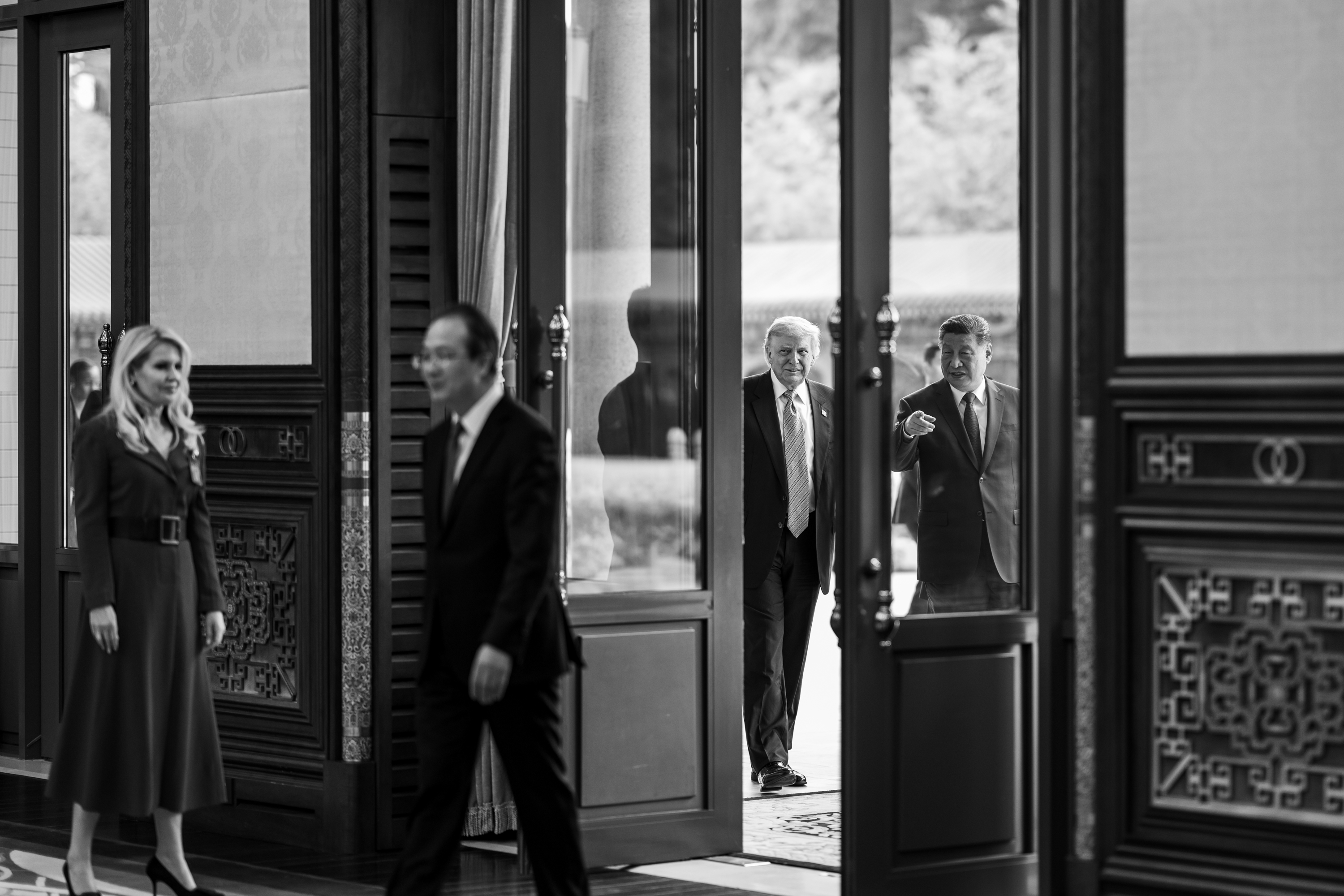
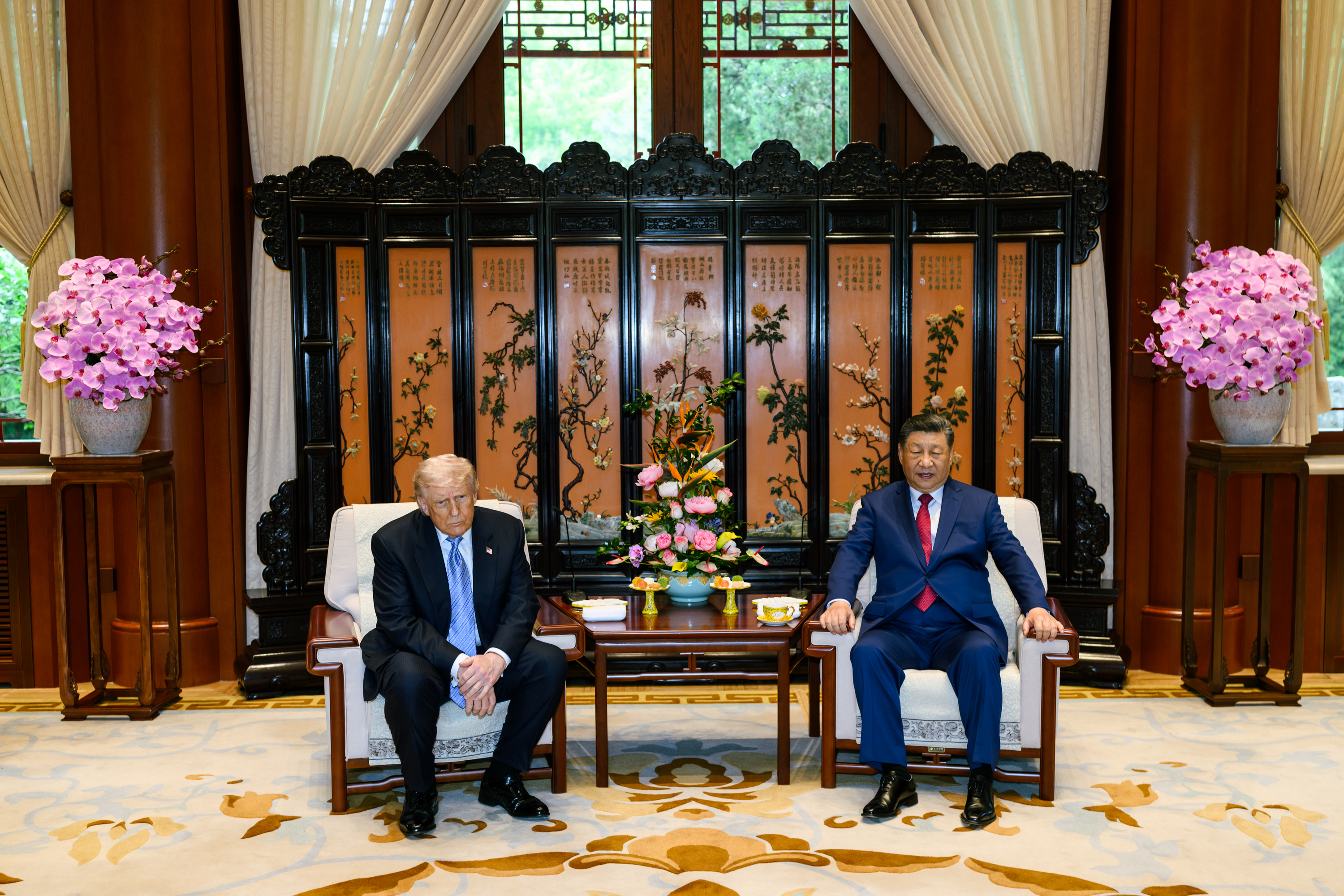
But on the morning of May 15, after their meetings and the official banquet were done, Xi did something rare. He brought Trump inside the walls of Zhongnanhai for a private tour and a working lunch.
Xi told Trump it was a thank-you. Back in 2017, during Trump's first term, Xi had come to Florida and stayed at Mar-a-Lago, Trump's private club and home. Xi said the Zhongnanhai invitation was meant to return the favor. One personal place for another.
The two leaders walked through the gardens together. Xi pointed out the ancient trees. He talked about the history. He even encouraged Trump to reach out and touch one of the older trees. At one point Trump looked around at the pavilions and the lake and said, "Nice place. I like it. I could get used to this."
Then they came across the roses.
The Zhongnanhai gardens are famous in China for their flowers, and the roses caught Trump's eye. Xi smiled and told Trump he would send some Chinese rose seeds back to Washington, so they could be planted in the White House Rose Garden. It was a small gesture. But for two countries that have spent years arguing over tariffs and trade and military buildups, a gift of rose seeds for the White House lawn meant something. It meant that, for at least one morning, the two most powerful men in the world were just two older gentlemen walking through a garden together.
The Real Reasons Trump Came: Rare Earths and the Iran War
Most American news coverage of the visit focused on the pageantry: the honor guard, the banquet, the garden walk, the rose seeds. Those mattered. But two urgent problems are what actually pulled Trump onto Air Force One and into Beijing. Both problems have the same answer at the bottom of them: China.
The Rare Earth Squeeze
Rare earths are 17 specific elements with names like neodymium, dysprosium, terbium, and yttrium. The name is a little misleading — they're not actually rare in the ground. What's rare is the ability to dig them up, separate them, and turn them into the high-strength magnets and components that modern technology depends on.
If you own any of these things, you depend on rare earths: a smartphone, a laptop, a flat-screen TV, headphones, an electric car or hybrid, an LED light bulb, a wind turbine, an MRI machine, a hearing aid, a solar panel. The U.S. military depends on them too — and not just a little. Every F-35 fighter jet uses about 920 pounds of rare-earth materials. A single Virginia-class submarine uses around 9,200 pounds. Tomahawk cruise missiles, precision-guided munitions, radar systems, satellites, and the Patriot missile system all need them. There is no substitute for the physics. You either have rare earths, or you don't have the weapon.
And here is the brutal math: China dominates this market more completely than any country dominates any other strategic resource on Earth.
The processing piece is the chokepoint that matters most. The United States has zero scaled capacity to separate the "heavy" rare earths (like dysprosium and terbium) that magnets need to keep working at high temperatures. Building that capacity takes five to seven years. There is no shortcut. Australia, Brazil, and Vietnam can dig the ore out of the ground, but turning that ore into the powder and magnets the U.S. economy actually uses still goes through Chinese factories.
In April 2025, in response to Trump's tariffs, China's Ministry of Commerce imposed export controls on seven of the most strategically important rare-earth elements, requiring licenses for every shipment. Six months later, in October 2025, Beijing tightened the screws again — adding five more elements, banning exports of the equipment used to process rare earths, and introducing what's now called the "0.1% Rule." Under that rule, any product made anywhere in the world that contains more than 0.1% Chinese-origin rare earths by value now requires a Chinese export license. China extended its reach across borders, the way the U.S. has long done with semiconductor controls.
For American manufacturers, this was a slow-motion emergency. Ford had to pause production of the Explorer in May 2025 because it couldn't get magnets. Defense contractors began stockpiling. The Pentagon (renamed the Department of War) invested $400 million in MP Materials, the only operating U.S. rare-earth mine, in July 2025 — making the U.S. government the company's largest shareholder. Independent analysts estimated that if Chinese rare-earth shipments stopped entirely, F-35 production would grind to a halt within 6 to 11 months. Virginia-class submarines would be next.
That is why Trump was in Beijing. A long-term solution will take years. A short-term solution requires China to keep approving export licenses. That requires a conversation at the very top.
The Iran War, and Why Only China Can End It
The other crisis on Trump's desk is the war with Iran, which began with U.S. and Israeli strikes in February 2026 and has not ended despite a temporary ceasefire and two failed rounds of Pakistan-organized negotiations. Iran responded to the strikes by partially blockading the Strait of Hormuz, the 21-mile-wide chokepoint at the mouth of the Persian Gulf through which roughly one-fifth of the world's oil normally passes. The blockade has cost the global market about 10 million barrels of oil per day — the largest oil supply disruption in history, larger than the OPEC embargo of the 1970s.
The U.S. has been working to plug that gap by surging its own oil exports by 3.5 million barrels per day, drawing heavily from the Strategic Petroleum Reserve. That works for a while, but the reserve is not infinite. Gas prices have already climbed at American pumps. Diesel costs are pushing up the price of everything trucks deliver, which is everything. American voters notice this quickly.
Here is where China comes in. China buys roughly 90 percent of Iran's oil exports. Iran provides about 13 percent of China's total oil imports. Most of these purchases happen through small, independent Chinese refineries called "teapots," concentrated in Shandong Province, that the U.S. Treasury has been sanctioning one at a time since March 2025. China and Iran also signed a 25-year "comprehensive strategic partnership agreement" in 2021 that runs across economics, security, and technology.
In plain English: China is the financial life support keeping Iran's government solvent. If China cut back its purchases of Iranian oil, or even slowed them, the Iranian regime would face a budget crisis on top of a war. Tehran might be forced to the negotiating table on terms the United States can accept. If China does not cooperate, Iran can keep paying for the war indefinitely, the Strait of Hormuz stays partially closed, gas prices keep climbing, and the global economy keeps absorbing damage.
This is the leverage Trump went to Beijing to obtain. After their first formal meeting on Thursday, Trump told Fox News that Xi had assured him China would not provide military equipment to Iran — a statement Trump described as "a big statement." That was the headline win Trump could publicly point to. The bigger ask — actually slowing the oil purchases — got softer language in the Chinese readout. Xi said Beijing would "work with the United States on regional hotspot issues" without committing to anything specific.
So that is what was really happening underneath the rose seeds and the state banquet. Trump needed two things only China could give him: continued rare-earth export licenses, and pressure on Iran. China wanted two things only the U.S. could give it: Nvidia AI chips, and Boeing aircraft. Neither side got everything it wanted. Both sides got enough to make the trip worth taking.
The Full Trip, From Start to Finish
The cable news shows gave you the highlights. Here's the whole story, hour by hour.
What the Cameras Didn't Show You
Unlike his 2017 visit, First Lady Melania Trump did not travel with the President this time. The American business delegation, however, was unusually large and included Elon Musk (who brought his young son), Tim Cook of Apple, and Jensen Huang of Nvidia. Xi himself stepped out of the main meetings to speak directly with these CEOs, a sign of how much China wants American business investment to continue.
Modern China: Not What You Think
Here's where most Americans need to update their picture.
The China that Trump just visited is not the China of the 1980s. It's not even the China of 2010. The country has changed faster than almost any country in human history.
- Cars on the road~1 million
- High-speed rail0 miles
- Skyscrapers in largest cityAlmost none
- Median household income~$600/yr
- Internet users0
- Annual passenger flights~5 million
- Global tech leadersNone
- Cars on the road~330 million
- High-speed rail~28,000 miles
- Skyscrapers in Shanghai~1,000+
- Median household income~$13,000/yr
- Internet users~1.1 billion
- Annual passenger flights~600 million
- Global tech leadersByteDance, Tencent (WeChat), Alibaba, Huawei, Xiaomi, Baidu, DJI
- Cars on the road~290 million
- High-speed rail~50 miles
- Skyscrapers in NYC~300+
- Median household income~$80,000/yr
- Internet users~330 million
- Annual passenger flights~850 million
- Global tech leadersApple, Microsoft, Nvidia, Google, Meta, Amazon
The picture is more honest than the simple "China is winning" or "America is winning" framing. The U.S. is still well ahead on per-person wealth, on commercial air travel, and arguably on the value of its top technology companies. China is well ahead on physical infrastructure, on the number of internet users and cars, and on raw industrial scale. Neither country is the country your grandparents remember.
China makes more electric cars than any other country. Cities like Shenzhen, which was a small fishing village in the 1980s, now have populations bigger than New York City. Shenzhen is also where most of the world's smartphones get put together, including a lot of iPhones.
Chinese companies you may not realize are Chinese include ByteDance, which owns TikTok. Tencent owns parts of major American video game studios. Alibaba is bigger than Amazon in many parts of the world. Lenovo, which makes laptops you can buy at Best Buy, started in China. So did Huawei, which became one of the largest makers of phone equipment on Earth before American sanctions slowed it down.
The Biggest Story Western News Doesn't Tell You
Here's something most Americans have never heard. By one of the two main ways economists measure the size of an economy, China's economy is already bigger than America's. And it has been for over ten years.
Economists use two yardsticks:
| Measure | What It Tells You | Who's #1 in 2026 |
|---|---|---|
| Nominal GDP | How much the economy is worth in U.S. dollars at today's exchange rate. Good for measuring financial power on world markets. | United States ($30T vs. China $19T) |
| GDP at PPP | Adjusts for the fact that a dollar buys more in China than in the U.S. Good for measuring real production, factories, and physical scale. | China ($41T vs. U.S. $30T) |
"PPP" stands for purchasing power parity. Think of it this way. A haircut in Beijing costs about $5. The same haircut in New York costs $40. Both haircuts give you the same service. So when you measure the Chinese economy in dollar terms, you make it look smaller than the real volume of stuff it produces. PPP corrects for that.
Most Western news headlines use the first number, nominal GDP. That's why you keep hearing "the U.S. is still the biggest economy in the world." On that measure, it is. By the second measure, China passed the U.S. back in 2014. Today, China's economy is about 37 percent larger than America's by PPP, and the gap is expected to widen to nearly 50 percent by 2030.
Both measures are real. Neither is fake. They just answer different questions. Nominal GDP answers "who has more financial power globally?" PPP answers "who actually makes more stuff?" The honest picture is that the United States is still on top in one race and China is already on top in the other.
This matters for how Americans should think about the Beijing trip. Trump wasn't visiting a poor cousin. He was visiting a country that, depending on how you count, is already the largest economy on Earth.
Some of this growth has come with real problems. Pollution. Surveillance. Limits on free speech. But the country itself is no longer poor, no longer cut off, and no longer behind the times. It is one of the two most powerful nations on the planet, and it is going to stay that way for the rest of our lifetimes.
This is what Trump saw on his trip. It's also why some experts said the trip itself was a way of showing him, in person, just how far China has come.
Why China Is 10 to 15 Years Ahead of the U.S. in Some Areas
Here's the part most American news shows skip. In several major industries, China isn't just keeping up with the United States. It is years, sometimes a full decade or more, ahead. This isn't a political claim. It's a factual one. Anyone who travels to a Chinese city can see it within hours of landing.
Here are six areas where the gap is real and measurable today.
What This Looks Like in Everyday Chinese Life
All those statistics about high-speed rail, solar panels, drones, and EV factories add up to something very real for ordinary Chinese people. Daily life in a major Chinese city in 2026 looks very different from daily life in an American one, and not in the ways most American TV shows would lead you to believe.
Money goes much further. A Chinese fast-food or retail worker on roughly $13,000 a year isn't living poorly. They're living a coherent, comfortable working-class life by the cost structure that surrounds them. A subway ride in Beijing costs about 50 cents. A meal at a casual restaurant runs $3 to $5. A high-speed train ticket from Beijing to Shanghai (about 800 miles, 4.5 hours) costs around $80. Basic healthcare is heavily subsidized. Public transit, broadband, and mobile phone service are all dramatically cheaper than in the U.S. That's why economists use the "purchasing power" measure for this — and why on that measure, the Chinese economy is now the world's largest. The actual Chinese middle class earns far more than $13,000, but even at the working-class baseline, life works out.
Side-by-Side: What Daily Life Actually Costs
Typical 2026 figures in U.S. dollars. Costs vary — tier-1 cities like Shanghai are pricier than smaller Chinese cities, just as New York is pricier than smaller American cities. These are middle-of-the-range comparisons.
| Item | Typical China | Typical United States |
|---|---|---|
| Median household income (year) | ~$13,000 | ~$80,000 |
| 1-bedroom apt, city center (month) | ~$560 | ~$1,750 |
| Basic utilities (month) | ~$50 | ~$200 |
| Mobile phone plan (month) | ~$10 | ~$70 |
| Home internet (month) | ~$15 | ~$70 |
| Single subway or bus ride | ~$0.50 | ~$2.75 |
| Car insurance + maintenance (month) | ~$45 | ~$280 (~$190 insurance + ~$90 maintenance) |
| Casual restaurant meal | ~$4 | ~$18 |
| Coffee at a café | ~$2 | ~$5 |
| Groceries (one person, month) | ~$175 | ~$450 |
| Health insurance (monthly premium) | ~$10-20 (state insurance) | ~$650 (just for access — visits, pills, deductibles all extra) |
| Doctor's office visit (out-of-pocket) | ~$15 | ~$200 |
| Emergency room visit | ~$75 | ~$2,700 (uninsured); $400-1,000 with insurance |
| Ambulance ride (ground transport) | ~$30 (heavily subsidized) | ~$1,500 (BLS/ALS national avg) |
| Childcare / daycare (one child, month) | ~$250 | ~$1,200 (avg; $550 in MS, $2,000+ in DC/MA) |
| K-12 school costs (per child, month, extras) | ~$75 | ~$200 (supplies, lunch, sports, after-school) |
| Public university tuition (one year) | ~$700 | ~$10,500 |
| 800-mile high-speed rail ticket | ~$80 | (no equivalent service) |
The ~$80,000 figure for the U.S. is median household income — meaning the typical American family with two earners pooled together. A solo American retail, fast-food, or service worker more typically earns $20,000 to $35,000 a year.
Let's actually do the math. Take an American fast-food worker on $30,000 a year and a Chinese fast-food worker on $13,000 a year. Run the essential bills:
| Annual Essential | U.S. ($30K worker) | China ($13K worker) |
|---|---|---|
| Rent (1BR, year) | $21,000 | $6,720 |
| Health insurance (year) | $7,800 | $180 |
| Car insurance + maintenance (year) | $3,360 | $540 |
| Just these three essentials | $32,160 | $7,440 |
| Left over from paycheck | -$2,160 (under water) | +$5,560 |
Item for item — housing, transit, healthcare, food, education — a Chinese paycheck stretches roughly 5 to 10 times further than an American one. The headline framing of "China is poor and America is rich" simply doesn't survive contact with the math at the bottom of the income distribution. Working-class Chinese live a fundamentally more comfortable, lower-stress life than working-class Americans, even though they earn less in dollar terms.
It's also far safer. China is one of the safest countries in the world by violent crime statistics. Civilian gun ownership is almost completely banned. The country sees fewer than 1 gun death per 100,000 people each year. The United States sees about 12 to 13 per 100,000 — more than ten times higher. Chinese parents don't sign their children up for active shooter drills. Chinese cities don't see school shootings or mass shootings in public places. Parks, subways, malls, and streets feel safe at all hours. There's a tradeoff. China achieves this safety through strict gun control and through extensive public surveillance. American readers can decide for themselves what they think of that exchange. But the safety is real, and Chinese people feel it every day.
Public spaces feel different. Walk through any Chinese city — not just mega-cities like Beijing and Shanghai, but smaller tier-2 cities most Americans have never heard of — and you won't see what's become normal in San Francisco, Los Angeles, or New York. No tent encampments under freeways. No people sleeping on subway grates. No panhandling at every intersection. The U.S. has roughly 580,000 people experiencing homelessness on any given night, with about 230,000 of them living unsheltered on the streets. Chinese cities show a tiny fraction of that visible presence. The system works very differently. When someone in China genuinely has nowhere to live, the government is required to step in. A national network of state-run relief stations (救助管理站) provides housing, food, and work placement. Under Chinese family law, adult children carry a legal duty to support their parents. And local officials are personally accountable — visible street disorder in their jurisdiction hurts their performance reviews and can derail their careers. The result is what an American visitor notices within an hour of landing: clean, orderly, unbothered public spaces in cities far larger than New York.
And it's strikingly more convenient. In many Chinese cities your dinner now arrives by autonomous drone in about 15 minutes, with no delivery fee. Robotaxis from Baidu, Pony.ai, and WeRide drive themselves to your door, no driver inside, in over a dozen cities. Air taxis from EHang are licensed to fly paying passengers across cities like Guangzhou and Hefei. Almost no one carries a wallet — practically every payment, from coffee to rent to hospital bills, happens with a quick QR code scan on a phone. None of this is a pilot program. It's daily life.
This is the gap that's hardest to see from American news coverage. It's not that China is "catching up." In a Chinese city in 2026, drones bring you dinner, robots drive your car, autonomous flying taxis are licensed for paying passengers, and your money buys far more than the exchange rate suggests. The future arrived in China first.
What About the Areas Where Western News Says America Leads?
For decades, the standard story in American media has been that even if China has caught up on infrastructure and manufacturing, the United States still leads on universities, on science, on medicine, on the military, on space, and on the future. The honest 2026 picture is more complicated than that. Here's an even-handed look at the areas most often cited.
What the U.S. Still Has Going for It
Even with all of that, the United States holds some real and durable advantages that don't show up in any ranking of factories or rail miles.
The U.S. dollar is still the world's reserve currency, and most international trade is settled in dollars. The New York Stock Exchange is still the most important financial market on Earth. American brands like Apple, Coca-Cola, Disney, Nike, Netflix, and McDonald's are recognized in nearly every country in the world, and American movies, music, and sports culture still shape what billions of people watch and listen to. The U.S. holds a large lead in commercial rocket launches thanks to SpaceX. It is still the world's largest oil and natural gas producer. American agriculture is the most productive on Earth. And the U.S. attracts more international students, more foreign investment, and more immigration than any other country.
So the honest summary is this. The simple "America is #1 at everything" story that many Americans grew up with is no longer true in 2026. The "China is collapsing and copying everything" story is also not true. Both are great powers. China is ahead on physical infrastructure, manufacturing scale, and rolling out new technology to ordinary people. The U.S. retains real strength in finance, in soft power, in commercial space, and in some specific cutting-edge fields. Most other areas the press still describes as "American dominance" are actually contested today, with the gap narrower than most U.S. news consumers realize.
What this means for the Beijing trip is simple. Trump was not visiting a country trying to catch up. He was visiting a country that has already passed the United States in several important areas and is keeping pace or pulling ahead in many others. That's why the deals, the chip approvals, and the trade talks matter so much. They aren't favors. They are negotiations between two countries that genuinely need each other.
Why This Could Be a Win-Win
So what did Trump actually bring home? And why might this trip end up helping ordinary Americans?
Start with the deals.
Boeing is based in Virginia and builds its planes in Washington State, South Carolina, and Texas. Each one of those planes represents thousands of American jobs. Mechanics. Engineers. Welders. Suppliers in every state. Two hundred planes is one of the biggest single aircraft orders in history.
The U.S. Department of Commerce also approved ten major Chinese companies to buy Nvidia's powerful H200 computer chips. Nvidia is an American company. The H200 is one of the most valuable products in the world right now. Selling them to Chinese customers means billions of dollars flowing back to a California company that employs tens of thousands of Americans and pays American taxes.
For American farmers, more open Chinese markets could mean more buyers for soybeans, corn, beef, and pork. China has more than 1.4 billion people. They need food. American farms grow some of the best food in the world. When the two countries get along, American farmers sell more.
How Both Sides Made It Work
Big trade visits never go one direction. Both sides moved pieces to make this one happen.
On the U.S. side, the Commerce Department lifted earlier limits on selling Nvidia's most advanced AI chips to Chinese companies — a move worth billions in new revenue for a flagship American firm. The administration also suspended a planned $13 billion arms sale to Taiwan, the self-governing island China considers its own territory. Critics in Washington called these significant trade-offs; supporters called them practical groundwork for the much larger trade benefits that followed.
On the Chinese side, Xi committed to the 200-plane Boeing order, reopened market access for American agricultural goods, and personally invited Trump into Zhongnanhai — an honor extended to only three other U.S. presidents in 54 years. Trade visits at this level work when each side gives the other enough to make the bigger picture possible.
The two sides also agreed to what Xi called "constructive strategic stability." That's a fancy phrase, but here's what it means in plain English. The two sides agreed they were competitors. They didn't pretend to be best friends. But they also agreed to talk to each other, to keep the lines open, and to try to avoid the kind of misunderstandings that can lead to war.
That matters. The United States and China have the two largest economies and the two most powerful militaries on Earth. If they ever went to war, it would be the most devastating event in human history. Millions of people would die. The global economy would collapse. Every family in America would feel it.
This isn't just good for Americans and Chinese, either. The rest of the world benefits when the two biggest powers cooperate. European countries that depend on global trade do better. African countries trying to grow do better. Latin American countries selling food and minerals do better. Even smaller Asian nations, who often worry about being squeezed between the two giants, do better when those giants are talking instead of fighting.
The Hard Problems Haven't Gone Away
There are still hard problems. Taiwan remains the most dangerous flashpoint. Xi told Trump that mishandling Taiwan could put the whole U.S.-China relationship in jeopardy. The two sides also disagree on technology, on human rights, and on China's friendship with Russia and Iran. No formal trade treaty was signed during the trip. Most of what came out of Beijing was framed as agreements in principle, not legal commitments.
But for the first time in years, the leaders of both countries were in the same room. Walking through the same garden. Looking at the same 490-year-old tree. Drinking from the same cups of tea.
That tree was already standing during the Ming dynasty. It was standing when George Washington was a boy. It will probably still be standing long after every politician alive today is gone.
That's the part of the trip the cameras almost missed. Two leaders, in a garden older than either of their countries, trying to figure out how to share the world.
A Common Myth: Who Actually Pays the Tariffs?
One of the most stubborn misunderstandings in American politics is the idea that tariffs on Chinese goods are "won" by the United States and "paid by China." That isn't how tariffs work, and this isn't a political claim. It's basic economics that nearly every major U.S. financial institution agrees on.
A tariff is a tax that the U.S. government charges on imported goods at the border. The check is written by the American company importing the product, not by the Chinese exporter. Multiple recent studies confirm those costs are then passed along — first to U.S. businesses, then to U.S. consumers — through higher prices on store shelves.
The numbers, from American sources, are clear:
The Federal Reserve Bank of New York's February 2026 analysis found that 86 percent of tariff costs are passed through to U.S. import prices. The Federal Reserve's March 2026 study showed prices on goods imported from China rose 8.5 percent in 2025 alone, directly traceable to tariff increases. In plain English: when tariffs go up, the bill ends up on the kitchen table of an American family. The dishwasher costs more. The kid's bike costs more. The phone case, the kitchen gadget, the holiday toys — all more expensive.
Chinese exporters often respond not by paying the tariff, but by shifting production to other countries like Vietnam, Mexico, or Indonesia, or by accepting slightly lower margins. They don't write checks to the U.S. Treasury. The U.S. Treasury is paid by the American importer first, who then passes the cost along.
None of this means tariffs are inherently good or bad. There are real arguments on both sides about whether tariffs protect American manufacturing, give the U.S. negotiating leverage, or shield strategic industries from foreign competition. Those are legitimate debates. But anyone making those arguments has to start from the same factual ground: it is American businesses and consumers who carry the immediate cost, not China. The Beijing trip was, in part, an attempt to ease that pressure on both sides.
A Quick Taiwan Refresher
Taiwan came up over and over in the meetings — at the formal talks, at the state banquet, and during the Zhongnanhai walk. Xi told Trump that Taiwan is "the most important issue in China-U.S. relations" and that mishandling it could put the entire relationship in jeopardy. To understand why Taiwan is the most dangerous issue between the two countries, it helps to know a little history. Most American news coverage skips this part.
Where the People Came From
Taiwan is an island about 110 miles off the southeast coast of mainland China. Roughly 23 million people live there. The overwhelming majority — about 95 percent — are ethnic Han Chinese, the same ethnic group that makes up about 92 percent of mainland China. Their ancestors came to Taiwan from the mainland over the course of hundreds of years.
Most of those ancestors came from a single mainland Chinese province: Fujian, directly across the strait from Taiwan. Beginning in the 1600s, large numbers of Hoklo Chinese — speakers of a Fujian dialect — sailed across to settle Taiwan. They brought their language, their food, their religion, and their family structures. A smaller wave came from the neighboring province of Guangdong (the Hakka community). About 2 percent of today's Taiwanese are indigenous Austronesian peoples whose ancestors lived on the island for thousands of years before any Chinese arrived.
The 1949 Rupture
The biggest single moment in modern Taiwanese history happened in 1949. After Japan lost World War II and gave back Taiwan (which Japan had ruled for fifty years), China's civil war was nearing its end on the mainland. Mao Zedong's Communists won. The losing side — Chiang Kai-shek's Nationalist Party, called the KMT — fled across the strait to Taiwan, bringing with them roughly one to two million soldiers, government officials, and civilians from cities all across the mainland. Many were from Fujian and the nearby provinces, but plenty came from farther afield. They expected to retake the mainland someday. They never did.
Family on Both Sides
Here's the part most Americans never hear. Taiwanese society and mainland Chinese society are connected by family. Many older Taiwanese were born in mainland China and moved to Taiwan as children or young adults during the 1949 retreat. Decades later, many still have brothers, sisters, cousins, parents, and grandparents on the mainland. Flights between Taiwan and mainland Chinese cities are routine. Couples marry across the strait. Taiwanese companies have invested hundreds of billions of dollars in mainland Chinese factories. The two sides share a language — Mandarin — with some accent and vocabulary differences (similar to British versus American English). They share a cuisine, a calendar of holidays, the same characters in writing, and a long history that runs back thousands of years.
To make it relatable: imagine if a state like Texas or Alaska had been separated from the United States by a foreign power for fifty years, and then ended up as a politically separate country with its own flag and government — but where everyone still spoke English, ate American food, celebrated the Fourth of July, and had family living back on the mainland. American flags would still be everywhere. Country music would still be on the radio. After several generations, most Americans on the mainland would probably feel deeply that Texas was still "one of us," even if Texans operated under their own elected government. The desire to bring it back wouldn't be something the federal government had to manufacture. It would be a shared popular feeling that something that belongs together had been forced apart. That, broadly speaking, is the emotional logic that drives how mainland Chinese people feel about Taiwan.
For readers elsewhere in the world, similar dynamics exist closer to home, and they may feel more familiar than the American example:
- Germans lived this from 1949 to 1990. East and West Germany were split by Cold War politics — same people, same language, the same family names on both sides of the Berlin Wall, and a deep popular yearning for reunification that finally happened peacefully in 1990. Most West Germans didn't need their government to tell them to feel that way. They simply did.
- Koreans are living it now. North and South Korea have been divided since 1945, with millions of families separated to this day. The two governments dispute legitimacy, but on the streets, ordinary Koreans on both sides describe each other as kin.
- Cyprus has been divided since 1974, when the island split into a Greek-speaking south and a Turkish-speaking north. Families on both sides of the Green Line share kinship, history, and food, but a generation has now grown up on each side under separate governments, and reunification talks have stalled repeatedly. Same island, different flags, unresolved.
- Spaniards have their own long-running version with Gibraltar, the British-controlled territory at Spain's southern tip that Spain has claimed as historically theirs since 1713. Same peninsula, different flag, ongoing political dispute.
- Irish readers recognize the pattern in the long history of Ireland and Northern Ireland: shared heritage, complicated politics, and a slow path toward whatever future the people on both sides eventually decide.
None of these situations are identical to China and Taiwan. Each has its own history, its own legal posture, and its own modern political context. But the underlying emotional logic — a people that history split wanting to come back together — is one that shows up across every continent and that humans seem to recognize instinctively, wherever it appears.
So Why the Tension?
The disagreement, in other words, is political — not ethnic. Beijing considers Taiwan a province of China and wants reunification, peacefully if possible. And this is not just the Chinese government's position — it is a deeply held popular sentiment. Surveys conducted in mainland China consistently show that a strong majority of ordinary Chinese citizens — typically in the range of 70 to 90 percent — favor reunification with Taiwan. It is one of the few political questions where the government's stance and the public mood are aligned across nearly every region, age group, and class. For mainland Chinese, the issue is not abstract. It's a piece of the country that, in their view, history separated by accident.
And the sentiment runs in both directions across the strait, at least partially. A significant number of prominent Taiwanese figures have publicly endorsed the "One China" framework or proudly identified as Chinese. They include singer Angela Chang, who performed at Beijing's CCP centennial celebration; actress and cellist Ouyang Nana, who has openly declared herself Chinese; Mandopop stars Show Lo, Leehom Wang, Jiro Wang, and Annie Yi; supermodel Lin Chih-ling; and the entire Taiwanese band Mayday, whose lead singer Ashin told fans at a Beijing concert, "We Chinese, when we come to Beijing, must eat roast duck!" By one Taiwan press count, 42 of Taiwan's top celebrities publicly congratulated the PRC on its 70th anniversary in 2019. Critics in Taiwan note that many of these stars also have large mainland fan bases and business interests, so the support is not purely organic. But the fact that so many of Taiwan's biggest names lean toward "One China" tells you the question is genuinely contested inside Taiwan, not just imposed from outside.
That said, on the island as a whole, the political mood has shifted. About two-thirds of Taiwanese today describe themselves as "Taiwanese only" rather than "Chinese" or "both" — a number that has climbed significantly since the 1990s as younger generations have grown up under democracy. Taiwan has its own democratically elected government, its own military, its own currency, and increasingly its own distinct identity. The United States does not formally recognize Taiwan as an independent country; Washington follows a "One China" framework. But the U.S. does sell Taiwan defensive weapons and informally supports its right to self-government.
That's the powder keg Trump and Xi were navigating in Beijing. It isn't ancient. It isn't simple. It is, in many ways, a family quarrel that became a geopolitical fault line — and it's why the suspended $13 billion arms sale to Taiwan and the discussions about it dominated so much of what the two leaders said behind closed doors.
Looking Ahead: A 2035 Projection
If today's picture surprises you, the next ten years are going to surprise you more. Most major economic forecasters — Goldman Sachs, the International Monetary Fund, the Centre for Economics and Business Research (CEBR), the International Energy Agency, Citi, and the U.S. Department of Defense — now broadly agree on what the world will look like in 2035. Some of their projections move in the same direction. A few diverge sharply. But the overall picture they paint is not the picture most American readers have in their heads.
The Economic Race: A Crossover Around 2035
By nominal GDP — the dollars-at-today's-exchange-rate measure most American news headlines use — the United States is currently still the world's largest economy. China is closing the gap and is projected to close it by roughly 2035. Goldman Sachs places the crossover around 2035. CEBR places it at 2036. Citi puts it in the mid-2030s. None of these projections were considered fringe — they are the consensus of mainstream Western financial institutions.
By the other major measure — GDP at purchasing power parity (PPP) — China already passed the U.S. in 2014 and is now roughly 37 percent larger. By 2030, China's economy will be about 50 percent larger by this measure. By 2035, the gap is expected to widen to around two-thirds larger. This is the measure that matters for actual production, manufacturing capacity, and how much "stuff" an economy makes. By this measure, the question of "who is bigger" was settled a decade ago.
What this means in practice: by 2035, China will be the world's largest economy by every measure that matters for industrial capacity. The U.S. will still be the world's largest financial economy — Wall Street, the dollar, and global capital markets are not going anywhere quickly — but the center of gravity for global production, manufacturing, and physical output will sit firmly on the Chinese side of the Pacific.
The Clean Energy Race: Already Won
If there is one race where the 2035 picture is already essentially decided, it is the clean energy race. China is not just leading. China has already won the speed contest, and the only remaining question is how far ahead it ends up.
In September 2025, Chinese President Xi Jinping announced China's 2035 climate target at the UN Climate Summit: 3.6 terawatts of wind and solar capacity by 2035 — more than six times China's 2020 level. Analysts noted that at the current installation pace, China could hit that target as early as 2030, five years ahead of schedule. By comparison, the United States has roughly 280 gigawatts of installed wind and solar today and is projected to reach about 900 gigawatts by 2035 — meaning the U.S. in 2035 will have about one-fifth the wind and solar capacity China has today, let alone where China will be in 2035.
China already accounts for roughly 60 percent of all new global renewable capacity added each year, per the IEA. China dominates global solar manufacturing (about 80 percent of panels worldwide), wind turbine production, lithium-ion batteries (CATL and BYD lead globally), and the entire supply chain that the world's energy transition depends on. For the U.S. to catch up on the manufacturing side alone would require a 15- to 20-year industrial buildout — and even that assumes domestic raw materials and trained workforce, both of which the U.S. lacks at scale today.
The Electric Vehicle Future: Already Mainstream
The electric vehicle picture in China is similarly decided. In 2020, EVs (including plug-in hybrids) made up about 6 percent of new car sales in China. By 2025, that figure had crossed 50 percent. China's official 2035 target makes electric vehicles "the mainstream of newly sold vehicles" — and the country is set to hit that target with years to spare. China is now the world's largest auto exporter, surpassing Japan in 2023.
The Military Balance: A Narrowing Gap
The military picture is more complicated than the economic one, but the trend is unmistakable. In 2012, China's defense budget was one-sixth of the U.S. defense budget. By 2024, that ratio had risen to one-third. Chinese defense spending has grown at roughly 10 percent per year for two decades, while U.S. defense spending has grown at low single digits. If those trajectories continue — and there is no sign of either side slowing down — the gap closes substantially by 2035.
Three caveats matter for these numbers. First, Chinese military spending is widely believed to be substantially understated in official figures — most credible analysts estimate true Chinese spending is 30 to 60 percent higher than the published budget, which would put effective 2035 spending much closer to U.S. levels. Second, when adjusted for purchasing power parity (Chinese soldiers, fuel, ships, and missiles cost a fraction of what they cost in the U.S.), the effective military gap is already closing far faster than the dollar figures suggest. Third, the U.S. spreads its defense capacity across the entire globe, while China concentrates almost all of its military in one theater — the Western Pacific. In any conflict near Taiwan or the South China Sea, the relevant local balance is dramatically tighter than the global comparison suggests. The U.S. Department of Defense projects China will field roughly 1,500 nuclear warheads by 2035, up from about 600 today — pushing China close to nuclear parity with the U.S. and Russia for the first time in history.
The Demographic Wild Card
The one major area where the United States holds a structural long-term advantage is demographics. The Chinese population peaked in 2022 and is now declining. China lost about 1.4 million people in 2024 alone. By 2035, China's population is projected to fall from about 1.41 billion to around 1.32 billion — a loss of nearly 90 million people in a decade, roughly equivalent to the population of Germany. Meanwhile, the U.S. population is projected to grow slowly from about 333 million today to roughly 340 to 350 million by 2035, primarily through immigration.
- Total population~1.32 billion
- Aged 60+~400M (30%+)
- Population change 2024-2035-90M (Germany-sized loss)
- Workers per retiree2.8 (down from 4.4)
- Median age~48
- Total population~345 million
- Aged 60+~95M (~27%)
- Population change 2024-2035+12M (slow growth)
- Workers per retiree~2.4
- Median age~41
This matters more than it sounds. An aging, shrinking workforce eventually puts a hard ceiling on economic growth — fewer workers means less production. China's National Development and Reform Commission has already quietly revised its long-term growth target down from 4.8 percent to 4.2 percent annually, citing demographics. The Stanford FSI argues that China's demographic decline is real but will be slow, leaving Beijing a long runway of "peak power" through the 2030s before structural decline begins to bite. Other analysts argue China has already peaked. Both could be partially right — China can be both more powerful than today and on a long-term descending path.
Other 2035 Indicators at a Glance
Beyond GDP, energy, military, and population, the same convergence shows up across nearly every industrial and technological measure. Here's the broader 2035 snapshot from credible institutional forecasts.
| Indicator | China · 2035 | United States · 2035 |
|---|---|---|
| Manufacturing share of global output | ~32% (currently ~30%) | ~14% (currently ~16%) |
| High-speed rail (miles) | ~45,000 (from 28,000) | ~150–300 (from ~50) |
| R&D spending (annual) | ~$1.0 trillion (overtakes U.S. ~2030) | ~$900 billion |
| Battery production share (global) | ~70–75% (from ~80% today) | ~10–15% |
| 5G / 6G leadership | Leads on 5G; likely leads first to 6G | Closing on 5G; competitive on 6G |
| Frontier AI compute deployment | Closing fast; deployment-led approach | Still leads on raw frontier compute |
| Commercial space launches | ~250/year (rising) | ~400/year (SpaceX-led, still leads) |
| Reserve currency share | RMB ~7–10% of global reserves | USD ~50% (still dominant) |
| Nuclear warheads | ~1,500 (up from 600) | ~3,700 (stable) |
What 2035 Means for Americans
Put it all together, and the world of 2035 looks something like this. There are two great powers. They are economically roughly comparable in nominal dollars but China is substantially larger in real production. China dominates the energy of the future, the cars of the future, the batteries of the future, the supply chains for almost every advanced technology, and the rare-earth materials the U.S. military depends on. The U.S. still leads in finance, in soft power, in cutting-edge AI and biotech research, in commercial space, in oil and natural gas, and in the global appeal of its culture and immigration system. Neither country dominates the other. Neither country can decouple from the other without massive economic harm to itself. Both countries have nuclear arsenals capable of ending civilization.
This is the world Trump's Beijing trip was a small first step toward managing. Not the world of 2050. Not the world of 2025. The world of 2035 — ten years out, near enough that today's kindergartners will be in middle school when it arrives, and far enough that today's policy decisions still matter for how it plays out. The rose seeds will still be in the ground. Whether they bloom into anything more depends on whether two countries that genuinely need each other can keep walking through gardens together instead of meeting on battlefields.
The Bottom Line for Americans
If you take one thing away from this story, take this. The world that your grandparents lived in is not the world we live in now. The China of black-and-white photographs, of poverty and bicycles, is gone. The China of today is rich, powerful, modern, complicated, and not going anywhere.
Americans don't have to agree with how China runs itself. Most Americans don't. But Americans do have to deal with China. Every smartphone, every car, every piece of clothing, every appliance in your home was touched by China somewhere along the way. Every job in American farming, manufacturing, and technology has some connection to whether the two countries can find a way to work together.
The argument that runs underneath everything in this article — and that Trump's Beijing trip quietly endorsed — comes down to a sentence that is still uncomfortable for many Americans to say out loud: China is not our foe. China should be our strong ally. Not because either country is morally perfect (both have real flaws and will keep disagreeing on real things), but because the math of the 21st century is unforgiving. Two great powers that genuinely need each other — for rare earths, for medicine, for clean energy, for food supplies, for stable prices, for peace itself — gain more from partnership than from cold war. There are credible voices in Washington who disagree and argue that strategic competition is the only realistic frame. Their arguments are worth hearing. But the deeper one looks at the actual numbers — at the trade ledgers, the supply chains, the cost of conflict, the rate at which the rest of the world is moving — the more the case for partnership writes itself.
And for everyday Americans, this is not abstract. A working U.S.-China relationship — one that drops the trade wars and tariffs — translates into real money on every American kitchen table. As the earlier sections showed, tariffs added roughly 8.5 percent to the price of Chinese imports in 2025 alone, and 86 cents of every tariff dollar is paid by Americans, not China. The estimated bill for a typical U.S. household runs $1,000 to $2,000 more per year for the same goods. The categories that hit hardest are the ones every family buys: electronics (phones, laptops, TVs, headphones, gaming consoles), clothing and shoes (most apparel sold at Walmart, Target, and Amazon is made in China), home goods (furniture, kitchenware, tools, small appliances), toys and holiday gifts, generic medications and their active ingredients, solar panels and EV batteries for homeowners trying to lower their energy bills, and food — both directly, in items like seafood, frozen vegetables, and processed goods, and indirectly, because American farmers selling corn, soybeans, beef, and pork into Chinese markets keeps U.S. farm income up, which keeps domestic grocery prices stable. Partnership lowers all of these costs. Cold war raises all of them. The choice between "China as foe" and "China as ally" is not just a foreign policy abstraction — it shows up at the checkout line at Walmart, on the electric bill, at the gas pump, and in the grocery cart, every single week.
When Trump walked through Zhongnanhai, he wasn't just touring an old garden. He was reminding both sides that there is a lot at stake, and that getting along is worth the effort. The roses growing in the Zhongnanhai gardens this spring may yet end up planted in the White House Rose Garden. If they take root and bloom, they'll be a small but real reminder that the two biggest powers on Earth can choose to do something other than fight.
That's a win for Trump. It's a win for Xi. It's a win for Americans who want to keep their jobs and their peace. And it's a win for the rest of the world, who don't want to live in the shadow of a war between the two greatest powers of our time.
Sometimes the most important diplomacy doesn't happen at the negotiating table. Sometimes it happens on a garden path, beside an ancient tree, in front of a rose bush, between two men who realize they have more to gain by listening than by shouting.
That's what really happened in Beijing. And it may matter more than any single deal that was signed.