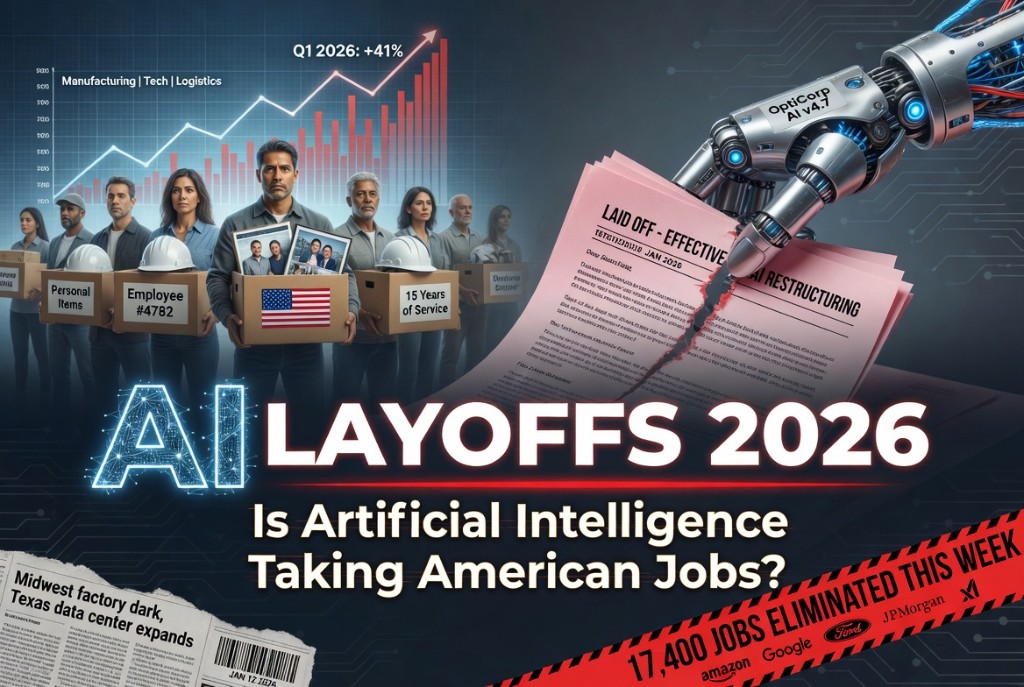
If you've been hearing that artificial intelligence is "coming for your job," you're not alone. It's one of the biggest stories in America right now — and the numbers are starting to back it up.
In just the first three months of 2026, approximately 78,557 tech workers were laid off. That's more than double the same period last year. And here's the part that has everyone worried: nearly half of those layoffs — about 37,638 — were directly blamed on AI and automation.
But is AI really replacing workers at this scale? Or are companies using the "AI excuse" to cut costs? And what is Congress doing to protect American workers? Let's break it all down.
What's Actually Happening?
Here's the short version: Companies are buying AI tools that can do some of the work that humans used to do. When those tools work well enough, companies lay off the humans and keep the AI. It's happening fastest in tech, but it's spreading to finance, logistics, consulting, media, retail, and manufacturing too.
The biggest single event was at Block, the company that owns Square and Cash App. In early March, CEO Jack Dorsey announced the company was cutting about 4,000 jobs — roughly 40% of its entire workforce. Dorsey didn't sugarcoat it. He said AI tools had fundamentally changed what it means to run a company, and that many human roles were no longer necessary.
Block wasn't alone. Here are some of the biggest AI-linked layoffs so far in 2026:
| Company | Jobs Cut | Industry | AI Connection |
|---|---|---|---|
| Oracle | 20,000–30,000 | Technology | Restructuring for AI-first operations |
| Block | 4,000 | Fintech | CEO directly cited AI replacing roles |
| Amazon | 30,000+ | E-commerce / Tech | Warehouse robots + corporate AI tools |
| Accenture | 11,000 | IT Consulting | "Those we cannot reskill will be exited" |
| Atlassian | ~10% | Software | AI-driven restructuring |
| Meta | 200+ | Social Media | Replacing managers with "AI builder" roles |
And it's not just tech companies. Over 45 CEOs across finance, logistics, consulting, retail, and manufacturing have publicly announced layoffs tied to AI. Citigroup, Dell, Intel, Microsoft, TCS, and UPS each cut over 10,000 positions where AI was cited as a factor.
But Is AI Really to Blame?
This is where things get complicated — and where you need to think critically about the headlines.
Some experts say companies are using AI as a convenient excuse for layoffs they would have made anyway. OpenAI CEO Sam Altman himself admitted that some companies are engaged in "AI washing" — blaming AI for cuts that are really about poor business performance, overhiring during the pandemic, or normal cost-cutting.
Cognizant's Chief AI Officer, Babak Hodjat, put it bluntly: "Sometimes AI becomes the scapegoat from a financial perspective, like when a company hired too many, or they want to resize, and it gets blamed on AI."
Here's a stat that supports the skeptics: over 80% of companies report no significant productivity gains from AI so far, despite billions of dollars in investment. That means many companies are cutting workers based on the promise of AI, not the proven results of AI.
On the other hand, Block's layoffs were different. The company didn't say AI might replace workers someday. It said AI tools had already replaced them — right now, today. Customer support, compliance processing, internal operations, and mid-level management roles were all eliminated because AI systems were handling those tasks. That's a real, measurable shift, not a vague promise.
Which Jobs Are Most at Risk?
Not all jobs are equally threatened. Based on what's happened so far and what researchers are finding, here are the types of work most affected:
High risk right now: Entry-level coding and software development, customer service and call center work, data entry and document processing, content writing and copywriting, compliance and document review, bookkeeping and basic accounting, logistics coordination and scheduling.
Growing risk: Mid-level management (organizing teams, reporting, scheduling), legal research and contract review, marketing analytics and ad optimization, translation and localization.
Lower risk (for now): Jobs requiring physical presence and complex judgment — healthcare workers, skilled trades (electricians, plumbers), teachers, social workers, creative roles requiring original human perspective, and jobs involving unpredictable real-world environments.
A Stanford study found that entry-level coding and customer service positions are already being significantly affected. An MIT simulation estimated that AI could replace nearly 12% of the entire U.S. workforce, amounting to roughly $1.2 trillion in lost wages.
Some of the most powerful voices in business are sounding alarms. Anthropic CEO Dario Amodei predicted that AI will cut entry-level white-collar jobs in half. Microsoft's AI chief, Mustafa Suleyman, said office jobs could "crumble" within 18 months. Ford's CEO said the same thing about his industry. Even Federal Reserve Chair Jerome Powell warned that AI is "quietly impacting the labor market" as job creation slows to near zero.
What Is Congress Doing About This?
This is where WhatsUpCongress comes in — because your elected representatives are starting to pay attention. Several bills have been introduced in the 119th Congress to address AI's impact on workers. Here are the most important ones:
Would require large companies to report quarterly to the Department of Labor whenever AI was a "substantial factor" in layoffs. The data would be compiled into public reports so Americans can see exactly which companies are cutting jobs because of AI, and how many.
Would create an AI Workforce Research Hub inside the Department of Labor to study how AI is changing jobs. Would also fund research into a "Rapid AI Adjustment Assistance Program" to help workers who lose their jobs to AI — similar to programs that help workers displaced by international trade.
Would create a bipartisan commission of Congress members and experts from industry, academia, and government to develop real solutions for workforce training, worker support, and keeping America competitive in an AI economy.
Would require companies with 11 or more employees to audit their AI tools for discrimination and bias, provide human oversight of AI-made employment decisions, and disclose when AI is being used in hiring, firing, or performance reviews.
In March 2026, the White House also published a "National AI Legislative Framework" with recommendations for Congress. It called for incorporating AI training into existing education programs, expanding research on workforce impacts, and — notably — pushing for federal law to override the patchwork of state-level AI regulations that companies currently face.
The Bigger Picture: Why This Matters for Everyone
Even if you don't work in tech, AI layoffs affect the entire economy. When tens of thousands of well-paid workers lose their jobs at once, they spend less money at restaurants, shops, and local businesses. Housing markets soften. Tax revenue drops. The ripple effects reach every community in America.
There's also a generational dimension that's especially important for young Americans. If AI takes over entry-level jobs — the jobs that recent graduates use to build experience and learn their fields — then an entire generation could be locked out of career paths that used to be their ticket to the middle class. As Cognizant's AI chief warned: "There's going to be a ton of people coming out of school that can't find a job and don't have the domain expertise."
But it's not all doom and gloom. AI is also creating new jobs. Companies need people who can build, manage, and oversee AI systems. They need workers who can combine human judgment with AI tools to produce better results than either could alone. The question isn't whether AI will change the job market — it absolutely will. The question is whether we prepare for that change, or let it steamroll workers who never saw it coming.
That's a question only Congress, employers, educators, and voters can answer together. But you don't have to wait for Washington to act. There are things you can start doing right now.
What Can You Do Now to Prepare for an AI World?
Whether you're a student, a worker in mid-career, a parent, or someone looking for a new job, here are practical steps you can take today to stay ahead of the curve.
1. Learn to use AI — don't just fear it
The people who will thrive in an AI economy aren't the ones who ignore it. They're the ones who learn how to work with it. Start experimenting with AI tools like ChatGPT, Claude, Google Gemini, or Microsoft Copilot. Use them to help with writing, research, brainstorming, and organizing information. The goal isn't to become a programmer — it's to understand what AI can and can't do, so you can use it as a tool rather than be replaced by it. As Cisco's CEO put it: "You shouldn't worry as much about AI taking your job as you should worry about someone who's very good using AI taking your job."
2. Build skills that AI can't easily replace
AI is great at pattern recognition, data processing, and repetitive tasks. It's bad at understanding nuance, navigating complex human relationships, making ethical judgments, and doing physical work in unpredictable environments. Focus on skills like critical thinking, communication, leadership, negotiation, creative problem-solving, and hands-on technical work. These "human skills" become more valuable as AI handles the routine stuff.
3. Don't stop at one skill set
The workers hit hardest by AI are the ones who specialize in a single task that a machine can learn. The safest workers are the ones who can do multiple things — who combine technical knowledge with people skills, or industry expertise with data literacy. Think of yourself as a "T-shaped" person: deep in one area, but broad enough to adapt when that area changes.
4. If you're in school or just starting out — choose wisely
Entry-level jobs are the first to go. That means getting real-world experience is more important than ever. Look for internships, apprenticeships, and hands-on projects, even if they're unpaid or part-time. The most in-demand fields right now include healthcare, skilled trades (electricians, plumbers, HVAC technicians), cybersecurity, AI/data management, renewable energy, and any role where you combine technology skills with deep knowledge of a specific industry.
5. If you're mid-career — start upskilling now
Don't wait until your company announces layoffs to start learning new things. Many community colleges, online platforms (Coursera, edX, LinkedIn Learning, Google Career Certificates), and even public libraries offer free or low-cost courses in AI literacy, data analysis, project management, and digital skills. Some employers will even pay for training — ask your HR department what's available.
6. Make your voice heard in Congress
The bills we described above — the AI-Related Job Impacts Clarity Act, the AI Workforce PREPARE Act, the No Robot Bosses Act — will only move forward if Congress hears from voters. Call or write your senators and representatives. Tell them you care about AI's impact on workers. Ask them where they stand on these bills. Every member of the House is up for re-election in November 2026. This is the year your voice matters most.
The Bottom Line
AI is already eliminating real jobs in 2026 — but the full picture is more complex than the headlines suggest. Some layoffs are genuinely driven by AI. Others use AI as a convenient excuse. Congress has introduced several bills to track, study, and respond to AI-driven job losses, but none have passed yet. The decisions made in Washington this year will shape whether American workers are protected or left behind.
Frequently Asked Questions
How many jobs has AI eliminated in 2026?
About 37,638 tech jobs were directly attributed to AI and automation in Q1 2026 — nearly half of ~78,557 total tech layoffs. Over 76% occurred in the U.S. A National Bureau of Economic Research study projects around 502,000 total AI-related job losses across all industries this year.
Which companies are laying off workers because of AI?
Major companies include Block (4,000 jobs), Oracle (20,000–30,000), Amazon (30,000+), Accenture (11,000), Atlassian (10%), and Meta. Over 45 CEOs have publicly cited AI as a driver of layoffs.
Will AI take my job?
It depends on your role. Jobs most affected right now include entry-level coding, customer service, data entry, content writing, and mid-level management. Jobs requiring physical presence, complex judgment, and original creativity are more resistant. An MIT study found AI could replace about 12% of the U.S. workforce.
Is Congress doing anything about AI and jobs?
Several bills have been introduced: the AI-Related Job Impacts Clarity Act (requiring companies to report AI layoffs), the AI Workforce PREPARE Act (creating a research hub), the Economy of the Future Commission Act (bipartisan expert panel), and the No Robot Bosses Act (requiring human oversight). None have passed yet.
Are companies really replacing workers with AI, or using it as an excuse?
Likely both. OpenAI's CEO acknowledged "AI washing" — blaming AI for cuts that would have happened anyway. Over 80% of companies report no productivity gains from AI yet. But companies like Block say AI directly replaced human roles, making it a genuine shift in some cases.
What is the AI-Related Job Impacts Clarity Act?
A Senate bill (S.3108) by Sen. Mark Warner requiring large companies to report quarterly to the Department of Labor when AI is a substantial factor in layoffs. It would create public reports tracking AI's real impact on jobs. The bill is in committee.
How do 2026 tech layoffs compare to previous years?
Q1 2026 saw ~78,000 tech layoffs, up from ~30,000 in Q1 2025 and ~57,000 in Q1 2024, but below Q1 2023's peak of ~168,000. The key difference: nearly 50% of 2026 cuts are attributed to AI, versus just 4.5% of all job losses in 2025.
What jobs are most at risk from AI?
Highest risk: entry-level coding, customer service, data entry, content writing, compliance review, bookkeeping, logistics coordination, and mid-level management. Lower risk: healthcare, skilled trades, teaching, social work, and roles requiring physical presence and complex human judgment.
Sources
- Tom's Hardware — "Tech industry lays off nearly 80,000 employees in Q1 2026 — almost 50% cut due to AI" (Apr 8, 2026)
- Fortune — "CFOs admit privately that AI layoffs will be 9x higher this year" (Mar 24, 2026)
- CNN Business — "AI isn't causing a jobs-pocalypse. At least, not yet" (Mar 2, 2026)
- TechRadar — "Nearly 80,000 tech workers have already lost their jobs in 2026" (Apr 9, 2026)
- Harvard Business Review — "Companies Are Laying Off Workers Because of AI's Potential—Not Its Performance" (Jan 2026)
- Programs.com — "List of Companies Announcing AI-Driven Layoffs" (Apr 2026)
- Tech Insider — "Tech Layoffs 2026: How AI Is Driving the Biggest Workforce Shift" (Apr 2, 2026)
- TweakTown — "Tech industry cuts 80,000 jobs in Q1 2026, with half attributed to AI" (Apr 8, 2026)
- Congress.gov — S.3108: AI-Related Job Impacts Clarity Act
- Congress.gov — S.3339: AI Workforce PREPARE Act
- Sen. Warner — "Economy of the Future Commission Act" (Mar 2026)
- Nextgov — "AI's impact on US workforce receives renewed legislative scrutiny" (Dec 2025)
- Baker McKenzie — "What the March 20 'National AI Legislative Framework' Means for US Employers" (Mar 2026)